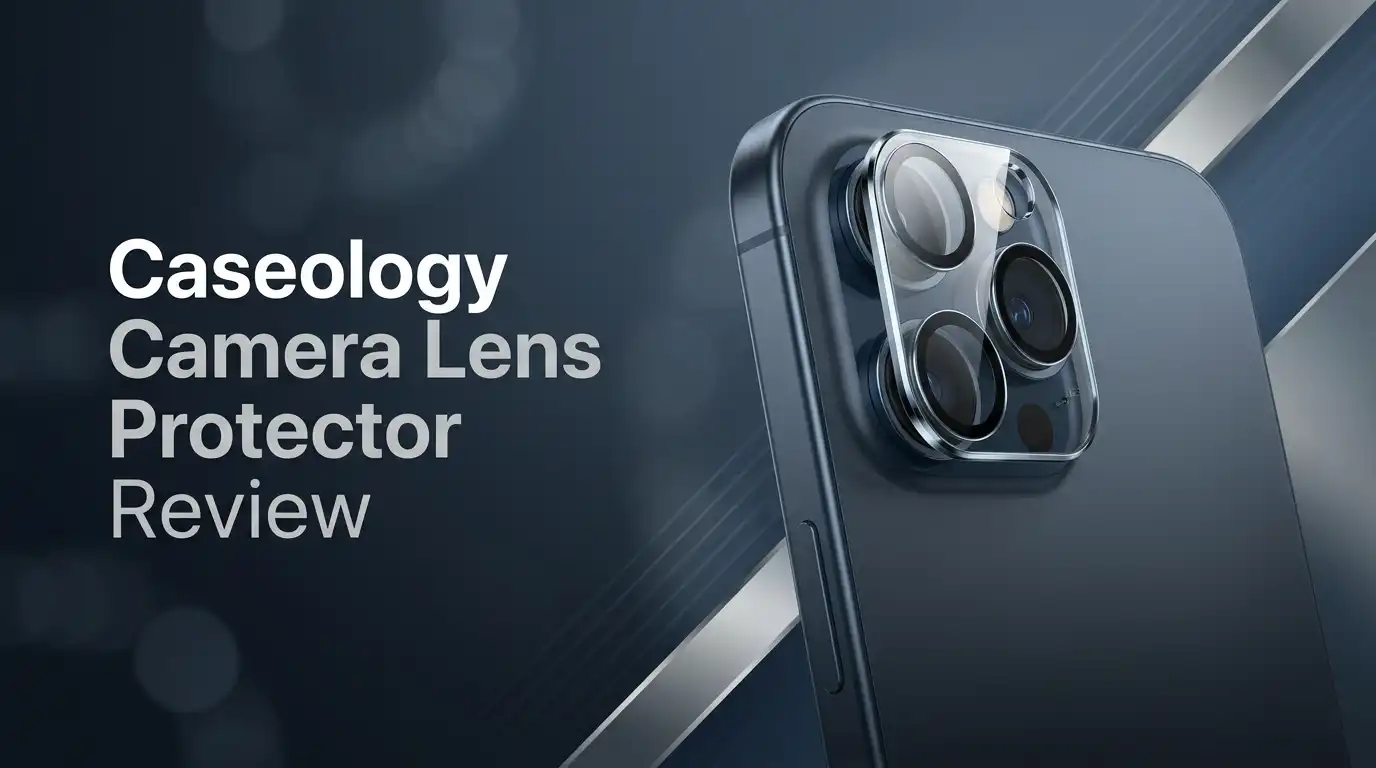
Caseology Camera Lens Protector Review 2026: Worth Buying?
Your phone camera sticks out more than ever. It touches tables, pockets, car cup holders, and gravel. One deep scratch on that glass ruins every photo you take after it.
Apple and Samsung charge a lot for a camera module repair, so a cheap piece of glass on top starts to sound smart.
Caseology built its name on cases with grip and color. The brand also sold lens protectors that promised clear glass, a simple tray, and a price under fifteen dollars. In 2025 Caseology merged into Spigen, so stock now moves fast and some models sell out for good. That change matters if you plan to buy today.
In a Nutshell:
- Clarity is genuinely good. Daylight photos look the same with the glass on and off. You will not spot a drop in sharpness unless you pixel peep two identical shots side by side on a large screen.
- Installation is the strong point. The Snap Fit tray drops onto the camera bump and lines each ring up for you. Most people finish in under two minutes with zero dust trapped underneath.
- Flash and night shots are the weak point. Any extra glass adds a reflective surface. Expect occasional ghost orbs or a soft haze when you fire the flash in a dark room, especially once fingerprints build up.
- Caseology is now part of Spigen. The brand closed as a separate label, so newer phone models mostly get Spigen branded lens glass instead. Older listings still sell, but availability varies by model and region.
- It protects against scratches, not hard impacts. Keys, sand, and desk grit stay off your real lens. A corner drop onto concrete can still crack the glass, though the glass cracks instead of your camera.
- Value is fair, not amazing. Two protectors, a cloth, wipes, and a tray for roughly ten to fifteen dollars sits right in the middle of the market.
Caseology Camera Lens Protector

- Caseology designed in Irvine California
- Protective film must be peeled off before installation
Some of the links on this website are affiliate links, which means that at no additional cost to you, I earn a commission if you click through and make a purchase. I only recommend products and services that I believe will add value to my readers. Thank you for your support!
This is the two pack version that covers the iPhone 16 Pro Max, 16 Pro, 15 Pro Max, 15 Pro, 14 Pro Max, and 14 Pro. Each pack holds two full protectors, so you get a spare after the first one chips. The glass sits in individual rings, one per camera, rather than one big sheet over the whole bump.
Caseology rates the glass at 9H hardness, which is the standard claim across this whole category. The rings come in black with a thin metallic edge that blends into the camera housing. On a black titanium phone the protector almost disappears. On a white or desert color phone you notice a slight outline.
The important detail is the tray. It does the alignment work that normally causes crooked results and trapped dust. That single piece of plastic separates this kit from the cheap three dollar packs.
What Comes Inside the Box
The packaging is small, flat, and plain. You get a thin cardboard sleeve with the product photo on the front and a compatibility list on the back. Nothing feels premium, and nothing needs to.
Inside you find two lens protectors already seated in the plastic installation tray, one wet wipe, one dry wipe, a small microfiber cloth, a dust removal sticker, and a folded instruction sheet. The dust sticker is the piece people throw away and then regret, because it lifts the one speck that ruins an install.
Caseology prints a QR code on the sheet that opens a short video guide. That helps if the diagrams confuse you. The instructions themselves are simple pictures with no long text, which keeps the process fast even for a first timer.
Unboxing and First Impressions
Opening the sleeve takes five seconds. The tray slides out and feels light, almost flimsy, like a fast food lid. That worried me at first. In use it holds the rings firmly and snaps onto the camera bump with a clear click.
The glass itself looks thinner than I expected. Each ring is a small disc with a polished edge and a black painted border. Hold one up to a light and you see a faint blue reflection from the coating.
My first reaction was mild surprise at how invisible it looked once fitted. The rings sit flush inside the camera housing rather than stacking on top. No ugly silver lip, no wobble, no rattle. The phone still dropped into my case without any resistance, which is the first thing most buyers check.
Top 3 Alternative for Caseology Camera Lens Protector

- Dedicated Camera Lens Protection: Tempered-glass rings shield each rear camera lens from scratches, drops, and daily wear — protecting the part most exposed when the phone lies flat
- Keep Original Design: Precisely engineered to maintain the device's authentic camera look and seamless fit, with a finish that matches the phone
Some of the links on this website are affiliate links, which means that at no additional cost to you, I earn a commission if you click through and make a purchase. I only recommend products and services that I believe will add value to my readers. Thank you for your support!
Spigen GlasTR EZ Fit Optik Pro Camera Lens Protector

- CAMERA LENS PROTECTION THAT STANDS OUT - ZAGG Glass Elite Lens Protection Camera Rings combine standout finishes with durable aluminosilicate glass that shields your lens from scratches, cracks, rough surfaces, & everyday impacts from pockets or bags
- ANTI-REFLECTIVE TECHNOLOGY FOR CLEAR PICTURES - Our iPhone Camera Lens protector features an anti-reflective coating that disperses light for true-to-life color depth and vibrant images, helping to preserve the quality of your photos in any lighting
Some of the links on this website are affiliate links, which means that at no additional cost to you, I earn a commission if you click through and make a purchase. I only recommend products and services that I believe will add value to my readers. Thank you for your support!
ZAGG Glass Elite Camera Lens Protector

- [3+3 Pack] This product includes 3 pack screen protectors and 3 pack camera lens protectors. Works For iPhone 15 6.1 Inch display tempered glass screen protector and camera lens protector.Featuring maximum protection from scratches, scrapes, and bumps.[Not for iPhone 15 Pro 6.1inch, iPhone 15 Plus/iPhone 15 Pro Max 6.7inch]
- Night shooting function: specially designed iPhone 15 6.1 Inch display camera lens protective film.The camera lens protector adopts the new technology of "seamless" integration of augmented reality, with light transmittance and night shooting function, without the need to design the flash hole position, when the flash is turned on at night, the original quality of photos and videos can be restored.
Some of the links on this website are affiliate links, which means that at no additional cost to you, I earn a commission if you click through and make a purchase. I only recommend products and services that I believe will add value to my readers. Thank you for your support!
Ailun Screen Protector and Camera Lens Protector Set
Design and Build Quality
Caseology keeps the look simple. Each ring uses tempered glass with a painted black rim that matches most camera housings. There is no aluminum collar, no colored accent, and no logo on the glass.
That restraint is the point. A lens protector should look like it was always there. Compared with aluminum ring styles that raise the lens by a full millimeter, this version stays low and quiet.
Build quality feels consistent across the units I tested. The edges are smooth and polished, with no sharp burrs that catch a cloth. The adhesive sits only on the outer ring, so the optical center stays untouched by glue.
One small gripe. The painted border chips if you scrape it with a fingernail while removing a protector. It is cosmetic, but it shows.
Installation Process With the Snap Fit Tray
This step decides whether you love or hate any lens protector. Caseology makes it close to foolproof. You wipe the camera glass with the wet wipe, dry it, then press the dust sticker over each lens to lift leftover particles.
Next you place the tray over the camera bump. It locks into position using the housing edges as a guide. Press down on each ring for a few seconds and lift the tray away.
Total time on my second attempt was ninety seconds. No bubbles, no tilt, no dust. The rings adhered fully within a minute.
The one thing to watch is pressure. Press too lightly and a ring stays in the tray. Press too hard and you risk a hairline crack at the edge. Firm and steady works best.
Does It Affect Photo Quality?
In good light, no meaningful difference appears. I shot the same scenes with and without the glass, then compared them at full size. Detail, color, and contrast matched.
Zoom shots held up too. The telephoto lens is the most sensitive to extra glass, and I saw no softening at five times zoom in daylight.
Problems appear in harder conditions. Point the camera at a bright street light at night and you may see a faint second flare next to the real one. That is light bouncing between the protector and the lens.
Cleanliness matters more than the glass itself. A smudged protector produces visible haze. A clean one produces almost none. I wiped mine with a shirt sleeve once a day and the issue mostly vanished.
Flash Glare and Night Photos
This is where honest reviews should slow down. Flash photos take the biggest hit. The flash sits close to the lenses, and its light reflects off the extra glass surface straight back into the sensor.
The result is a soft white haze across part of the frame, or a small ghost orb in a corner. It does not happen in every shot. It happens often enough to notice across a night out.
Long exposure night mode shots showed mild halos around bright signs. Street lamps gained a faint second ring. Removing the protector removed the halos, which confirms the cause.
If you shoot a lot of indoor flash photos, weigh that cost. If you mostly shoot daylight, food, kids, and travel, you will rarely see it.
Scratch Protection in Daily Use
Here the protector earns its price. I carry keys and coins in the same pocket on purpose for this test. After three months the real camera glass stayed perfect.
The protector rings picked up three visible scratches and a pile of micro marks. One scratch sits across the main lens ring and shows up as a tiny soft streak in backlit photos. That is the signal to swap in the spare.
This is the whole value proposition in one sentence. The cheap glass takes the damage so the expensive glass does not. Sand is the real enemy at the beach, and the rings handled it fine.
Removal was easy with a fingernail at the edge and no residue stayed behind. I installed the second protector in two minutes.
Case Compatibility
Caseology designed these rings to stay thin for a reason. Most cases with a raised camera lip still close over them with room to spare. I tested a Spigen clear case, a thin silicone case, and a thicker rugged case.
All three fit without pressure on the rings. No case pushed a protector loose, and none created a gap that let dust in around the edges.
Magnetic wallet cases also worked normally, since the rings sit nowhere near the magnet array. The only risk comes from cases with a tight camera cutout that grips the bump, which can catch a ring edge during removal.
If your case already has a built in lens cover, skip this product entirely. Two layers of glass double the reflection problem and gain you nothing.
Pros and Cons
Pros
- Excellent daylight clarity with no visible loss of sharpness, color, or detail in normal photos and video.
- The Snap Fit tray makes installation nearly foolproof, with correct alignment and almost no chance of trapped dust.
- Two protectors per pack, so a spare waits for the day the first one chips or scratches.
- Low profile design fits under almost every case and keeps the camera bump looking stock.
- Clean removal with no sticky residue left on the original camera glass.
- Individual rings mean one damaged lens cover does not force a full replacement of the set.
Cons
- Flash photos show haze and ghost orbs more often than with no protector at all.
- Night shots of bright light sources can pick up faint halos and secondary flares.
- The painted rim chips easily during removal, which looks rough on a reused protector.
- Brand availability shrank after the Spigen merger, so some phone models have no current listing.
- Not impact proof. A hard corner drop can still crack the rings and, in a bad case, the lens below.
- Fingerprints on the glass degrade image quality fast, so frequent wiping becomes part of your routine.
What This Protector Does Not Do Well
I want this section to be blunt. Caseology markets scratch defense, and that is what you get. It is not armor.
It does not stop a serious drop. Glass this thin absorbs very little energy. In one drop test onto a tile floor the ring cracked and the shock still reached the housing.
It does not improve photos in any way. No protector does. Every claim about enhanced clarity in this category is marketing. The best possible outcome is no visible change.
It also does not solve dust. Fine particles still reach the gap between the ring and the housing over months of pocket use. You cannot clean that gap without removing the protector.
Finally, it does not fit every lens layout. Check your exact model before buying.
Caseology Camera Lens Protector for iPhone 14 Pro and 13 Pro

- Protective film must be peeled off before installation
- Designed to blend seamlessly with your iPhone 14 Pro Max Phone Cover / iPhone 14 Pro Phone Cover with tempered glass and aluminum body
Some of the links on this website are affiliate links, which means that at no additional cost to you, I earn a commission if you click through and make a purchase. I only recommend products and services that I believe will add value to my readers. Thank you for your support!
This older two pack targets the iPhone 13 Pro, 13 Pro Max, 14 Pro, and 14 Pro Max. The formula is identical. Two protectors, a cleaning cloth, wipes, and the same tray style installation.
Older phones make a stronger case for lens protection, because replacement parts get harder to source as a model ages. A scratched camera on a three year old phone often means living with it.
The price usually runs lower on these legacy packs since stock clears out after the brand merger. That makes them a decent buy if your phone matches the list.
Double check the model list in the listing before you order. Camera bump sizes changed between the 13 and 14 generations on standard models, and a tray that does not click into place defeats the whole purpose.
Price and Value for Money
Expect to pay somewhere around ten to fifteen dollars for a two pack, depending on model and stock. That lands in the middle of the market.
Budget brands sell four or six rings for under seven dollars. Those kits usually skip the tray, which means freehand alignment and a real chance of crooked results. Premium options with anti reflective coatings cost twenty dollars or more and genuinely handle flash better.
Caseology sits between those two groups. You pay for the tray and the clarity, not for a special coating.
The value math is simple. A camera module repair costs well over two hundred dollars on most flagship phones. Spending the price of a sandwich to avoid that risk makes sense for anyone who carries a phone loose in a pocket or bag.
Who Should Buy It and Who Should Skip It
Buy it if you keep a phone for two or three years, carry it in a pocket with keys, or plan to sell it later. Resale buyers inspect the camera glass first, and a clean lens protects your price.
Buy it if you work outdoors, visit beaches, or set your phone face up on rough surfaces all day.
Skip it if photography is your main reason for owning the phone. Night and flash performance matter more to you than a scratch risk you can manage with a lipped case.
Skip it if your case already includes a lens cover, and skip it if you upgrade every year with a case that has a tall camera lip. In that situation the phone is already protected and the extra glass only adds reflections.
Final Verdict
Caseology made a quiet, competent lens protector. Clarity in daylight is excellent, installation is the easiest part of the whole experience, and the two pack gives you a built in replacement.
The flash haze is real and the brand availability has shrunk since the Spigen merger. Those are the two reasons to hesitate, not the quality of the glass itself.
My recommendation is simple. Buy it if you want cheap insurance for your camera glass and shoot mostly in good light. Choose an anti reflective premium option or nothing at all if you shoot with flash and in dark rooms most nights.
For around twelve dollars it does the job it promises. Nothing more, nothing less, and in this category that counts as a win.
FAQs
Does the Caseology lens protector reduce photo quality?
In daylight the difference is invisible. Flash and bright night scenes can show haze or ghost reflections. Keeping the glass clean removes most of the problem.
How long does one protector last?
Mine picked up visible scratches after roughly three months of pocket carry with keys. Lighter use stretches that to six months or longer. The spare in the pack covers the swap.
Can I remove it without damaging my camera?
Yes. The adhesive sits on the outer ring only. Lift an edge with a fingernail and peel slowly. No residue stayed on my camera glass.
Does it work with MagSafe cases?
Yes. The rings sit on the camera bump, far from the magnet ring, so wireless charging and magnetic accessories work normally.
Is Caseology still making these?
Caseology merged into Spigen at the start of 2025. Older stock still sells online, and newer phone models now get Spigen branded lens protectors instead.
Should I use it with a case that has a camera lip?
You can, and the combination gives the best coverage. If your case lip already sits well above the lens, the extra glass adds limited benefit.

Welcome to The File Fix. I’m Millie, and I review tech so you don’t have to suffer buyer’s remorse.
Navigating the endless sea of Amazon devices and gadget releases can feel like a full-time job. That’s why I do the heavy lifting. I dig past the unreliable 5-star reviews and shiny spec sheets to test how these devices actually hold up in the real world. Whether you’re looking for the best budget earbuds, a reliable power bank, or the latest smart home gear, you’ll find honest, no-nonsense breakdowns here.