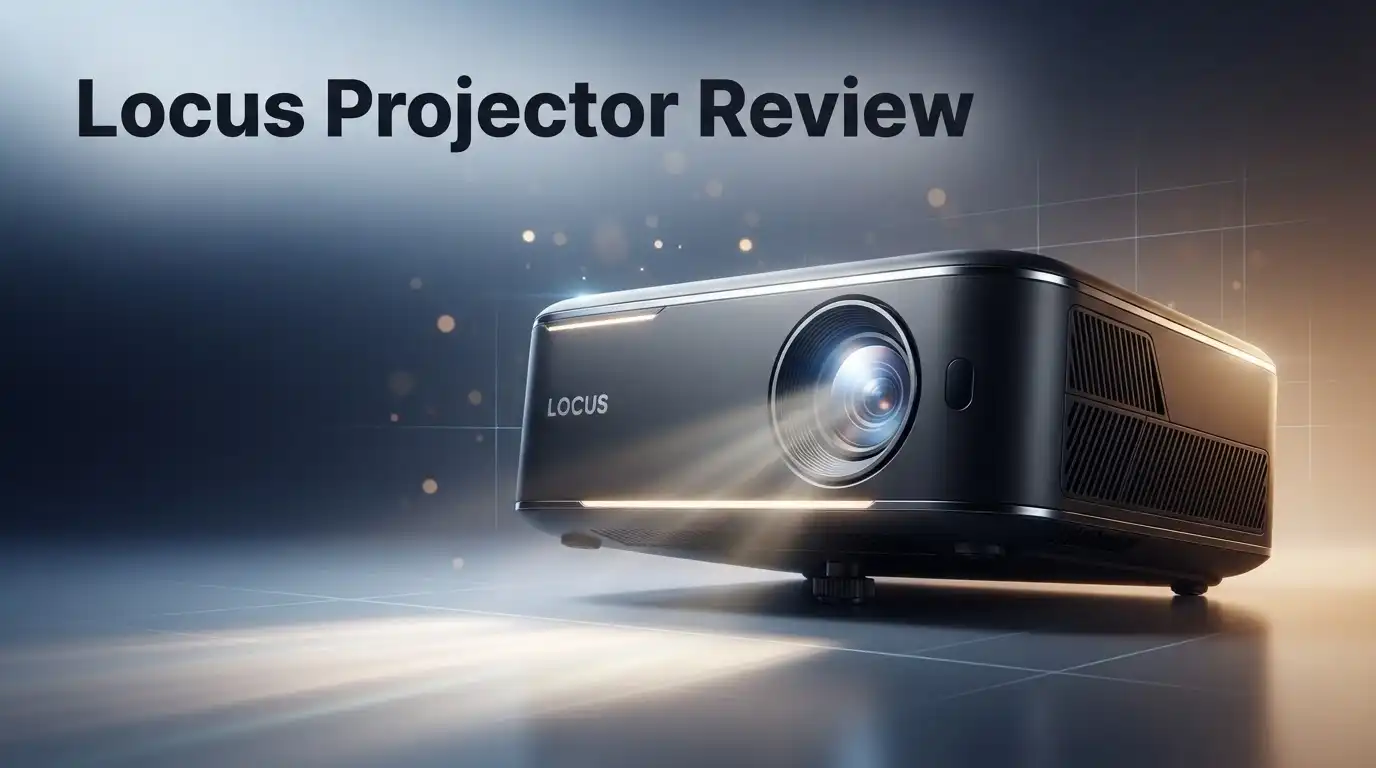
Locus Projector Review 2026: Worth Buying?
If someone offered you a $5,000 home theater projector for $400 cash out of the back of a van, would you take the deal? Thousands of people have. The box says Locus. The specs printed on that box promise 4K, 7200 lumens, 3D, and a 300 inch picture. The reality inside that box is something very different.
I dug through owner reports, teardown reviews, scam forums, and years of consumer complaints to put this Locus projector review together. What I found is consistent across every country where these units show up.
This review covers the unboxing, the real picture quality, the actual resolution, the sound, the smart features, and the honest value of the hardware. I also cover three projectors you can buy on Amazon instead that cost less and perform far better.
In A Nutshell:
- Locus is not a real consumer brand you can buy in stores. These projectors appear almost exclusively through parking lot sales, van sales, and sketchy online listings. There is no authorized retailer, no service center, and no support line that answers.
- The printed specs are false. Teardown testing on the Locus L300 showed a native resolution of 800 x 480, not the 1080p or 4K claimed on the packaging. The unit accepts an HD signal, then squashes it down.
- The brightness claim is the biggest lie. The box says 7200 lumens. Real world testing suggests something closer to 150 lumens, which is dimmer than a $120 mini projector from a normal brand.
- Actual hardware value sits near $150 to $250, including the flimsy screen and the ceiling mount. People routinely pay $400 to $1,500 for it.
- There is no usable warranty. The warranty card requires a receipt from an “approved supplier” that does not exist.
- Better options cost less. A BenQ HT2060, an Epson Home Cinema 2350, or a Nebula Capsule 3 Laser will beat it on every measurable point, with a real warranty attached.
What Is The Locus Projector?

- LED VIBRANT COLORS: The LED's long lamp life also produces rich DCI-P3 and 98% Rec.709 color coverage performance
- HIGH CONTRAST: Compatible with HDR10 and HLG, produces deeper black for fine details in dark scenes
Some of the links on this website are affiliate links, which means that at no additional cost to you, I earn a commission if you click through and make a purchase. I only recommend products and services that I believe will add value to my readers. Thank you for your support!
Locus is a label printed on a box. That is the most accurate description available. The brand has no factory, no product roadmap, and no retail footprint. Models like the Locus L200, L300, and L1050 show up with MSRP stickers between $4,000 and $6,900 printed right on the carton.
The same physical unit has circulated under other names too, including iKon, Axion, and Alumen. Only the case and the sticker change. Investigators who bought these units found identical internals and identical marketing copy across brands.
This is the projector version of the white van speaker scam, a sales trick that has run since the 1980s. The seller creates urgency, claims the gear is overstock or a canceled install, and offers a “discount” from a price nobody ever paid.
Locus Projector Review 2026: The Unboxing Experience
I will give credit where it is due. The unboxing feels expensive. The carton is large, glossy, and covered in authority badges from certification bodies that do not appear to exist anywhere.
Inside you get the projector, a universal ceiling mount, an IR remote, batteries, a composite cable, an HDMI cable, a spare fuse, and a printed manual. Some bundles add a pull down screen in a five foot long box.
The projector itself surprises people. It measures roughly 14 inches wide by 12 inches deep, much larger than typical LED units. That size is theater. A bigger chassis feels more professional in your hands, so the illusion holds until you plug it in.
The manual is genuinely decent, which suggests the factory building these is separate from the people selling them.
Design And Build Quality
Pick the unit up and the story changes immediately. It is big but very light. The weight does not match the footprint. There is a lot of empty air inside that shell.
The plastic feels thin. Panel gaps are uneven on many units. The lens ring turns with a gritty feel, and focus is manual only. There is no autofocus, no auto keystone, and no motorized anything.
Look for a UL or CSA safety certification mark. You will not find one. There is also no real UPC barcode, which tells you the product was never prepared for legitimate retail distribution in North America.
The remote is actually fine. It is a basic Android style clicker, and it works. That is the nicest thing I can say about the hardware package.
Top 3 Alternative For Locus Projector
- LED VIBRANT COLORS: The LED's long lamp life also produces rich DCI-P3 and 98% Rec.709 color coverage performance
- HIGH CONTRAST: Compatible with HDR10 and HLG, produces deeper black for fine details in dark scenes
Some of the links on this website are affiliate links, which means that at no additional cost to you, I earn a commission if you click through and make a purchase. I only recommend products and services that I believe will add value to my readers. Thank you for your support!
BenQ HT2060 1080p HDR LED Home Theater Projector

- 4K PRO-UHD (1) — An amazing 4K experience utilizing advanced processing for resolution enhancement, color and image processing; HDR10 (2) and HLG support produce an extraordinary range of color and detail in both bright and dark scenes
- Bright Picture — 2,800 lumens of color and white brightness (6) deliver a bright, vivid picture in a variety of lighting conditions
Some of the links on this website are affiliate links, which means that at no additional cost to you, I earn a commission if you click through and make a purchase. I only recommend products and services that I believe will add value to my readers. Thank you for your support!
Epson Home Cinema 2350 4K PRO UHD Smart Streaming Projector

- Laser Engine to Illuminate Your World: Experience vibrant visuals with this laser projector, featuring a laser light source delivering 300 ANSI Lumens of brightness in 1080p HD, ensuring your images stay bright and clear.
- Travel Light, Project Big: At just 2 lb (900 g) and 90% smaller than others with similar brightness, NEBULA Capsule 3 Laser projects up to a 120-inch screen and easily slips into your bag for presentations or movie nights anywhere.
Some of the links on this website are affiliate links, which means that at no additional cost to you, I earn a commission if you click through and make a purchase. I only recommend products and services that I believe will add value to my readers. Thank you for your support!
Nebula Capsule 3 Laser Portable Smart Projector
BenQ HT2060: The Projector Locus Pretends To Be
If you wanted a real home theater projector and nearly bought a Locus, this is the machine to look at. The BenQ HT2060 uses a genuine 1080p DLP chip with real pixel count behind it.
It throws a 100 inch image from about 8.4 feet. It offers vertical lens shift, 1.3x zoom, and 2D keystone, so placement is flexible in normal rooms. Input lag sits near 8.3ms at 120Hz, which gamers care about.
Color coverage hits DCI P3 and Rec.709 targets, meaning skin tones look correct instead of green. The LED light source runs tens of thousands of hours with no lamp to replace.
It costs a fraction of the fake Locus MSRP and it arrives with a real warranty. That combination ends the argument.
Picture Quality And The Real Resolution
Here is where the Locus falls apart. Independent teardown testing on the L300 measured a native panel resolution of 800 x 480. That is lower than a 720p phone screen from 2012.
Feed it 1080p over HDMI and the unit downscales the signal. Feed it composite video and you get roughly the same result. The input format barely matters because everything lands on the same low resolution panel.
Pixelation is visible. In fast motion your eye forgives it. On bright static scenes, subtitles, menus, or anything with text, the pixel grid jumps out immediately.
Watching sports or reading a menu on this thing is genuinely unpleasant. Contrast is weak too, so dark scenes turn into gray mush rather than black.
Brightness Claims Versus Reality
The box says 7200 lumens and a 250 watt lamp. Both claims fail basic physics. An LED small enough to fit inside this chassis cannot produce that output. If it could, no manufacturer on earth would still build lamp based projectors.
Testers who compared the Locus against known units placed it above a 100 lumen pocket projector and far below a 1600 lumen Epson. The honest estimate lands near 150 lumens.
What that means in your living room is simple. You need a fully dark space. Not dim. Dark. One lamp on in the corner washes the picture out completely.
Daytime viewing is impossible. Any claim about a 300 inch image is technically true only if you accept a picture too faint to watch.
Sound Performance
The built in speaker is loud. I will not pretend otherwise. It fills a bedroom without strain and stays clear at moderate volume.
Quality is another matter. Bass is absent. Dialogue sits forward, which helps with movies, but music sounds thin and boxy. Push the volume past two thirds and the cabinet starts to buzz.
For casual Netflix on a wall, it does the job. For a movie night with friends, you will want external speakers through the audio out or a Bluetooth bar.
This is the one area where the Locus performs about as well as its price bracket peers. Cheap projectors usually ship with terrible speakers, so a merely average one feels like a small win. It does not rescue the rest of the package.
Smart Features And The Android System
The Android build is the only genuine value in this box. Owners have reported Android 4.4.4 KitKat on the L300, with roughly 1GB of RAM and 8GB of storage.
That version shipped in 2013. Many modern streaming apps no longer support it. Netflix, Disney Plus, and YouTube may install, refuse to install, or install and then stop working after an update.
WiFi and wired LAN both function. The Play Store opens. Two USB ports let you connect a mouse or keyboard, which you will want because driving Android with an IR remote is painful.
Essentially you bought a dated Android TV box with a weak projector bolted to it. A $40 streaming stick outperforms this half of the product.
Setup And Everyday Use
Setup is manual from start to finish. You place the unit, twist the focus ring, and shove furniture around until the image squares up. There is no digital correction worth using.
You need distance. To fill the bundled screen you sit the projector about eight feet back. For a 100 inch image on a bare wall, plan on twelve feet of throw.
The fan is audible but not offensive. The box claims a 25dB fan, which is fiction, though it does not drown out dialogue.
The bundled screen is a letdown. The carton measures just over five feet long, so the screen inside maxes out near 75 inches in a 4:3 shape. Most buyers never unroll it twice.
Pros And Cons Of The Locus Projector
Every product deserves a fair column. Here is the honest split.
Pros
- The packaging and chassis look impressive, and the unit feels substantial when you first handle it.
- The bundled accessories are complete, including a universal ceiling mount, cables, remote, batteries, and a spare fuse.
- Android onboard means WiFi streaming and local media playback work without extra hardware.
- The built in speaker plays loud enough for a bedroom and stays clear at normal levels.
- Multimedia file playback from USB is reliable and handles most common video formats.
Cons
- Native resolution is 800 x 480, not the 1080p or 4K printed on the box.
- Real brightness sits near 150 lumens against a claimed 7200 lumens.
- No UL or CSA safety certification and no valid UPC code.
- The warranty card is unusable because no approved supplier exists.
- The Android version is over a decade old and breaks with modern streaming apps.
- Typical asking prices run three to ten times the actual hardware value.
What The Locus Projector Does Not Do Well
Let me be blunt about the failure points, because honest reviews name them.
It cannot handle ambient light. Any lamp, window, or open door ruins the image. It cannot display readable text at normal viewing distances, so gaming menus and sports scoreboards turn to blocks.
It cannot deliver real 3D despite the claim, and testers found no evidence of the processing required. The 100,000:1 contrast figure is not supportable in any measurement.
It cannot be serviced. No parts, no firmware updates, no support email that replies.
Most importantly, it cannot be resold near what you paid. One owner in Ontario unloaded his on a classifieds site for twenty dollars just to be rid of it. That is the resale market for this product in one sentence.
Price And Real Value: What Is It Actually Worth?
Set the MSRP sticker aside. It was invented to anchor your expectations high.
Reviewers who tested the internals compared it against known LED units and landed on a hardware value near $175. Add the screen and mount and you reach roughly $250 for the complete bundle, generously counted.
Sellers typically ask $400 to $1,500 in cash. Some buyers have reported paying $850 or more for a Locus plus speaker package.
Here is the simple test. If you paid over $300, you overpaid badly. At $20 on a classifieds site, it becomes a fun Halloween projection toy and nothing more.
The value gap is the entire business model. Nothing about the hardware justifies the ask.
How To Spot A White Van Projector Scam
Recognizing the pattern protects you and everyone you know. The script barely changes.
A stranger approaches you in a parking lot, often near a bank or hardware store. He claims to be an installer with leftover stock from a canceled job. He says his boss told him to move it fast. He shows you a printed MSRP and offers a steep discount for cash only.
The pitch always implies you are getting slightly shady goods. That framing is deliberate. It makes you feel clever and stops you from asking questions.
Real warning signs include brand names you cannot find on ProjectorCentral, no UL certification mark, specs that beat flagship gear at a tenth of the price, and cash only terms with no receipt or return window.
Walk away. Every time.
Who Should Buy The Locus Projector?
Almost nobody. There is one narrow exception worth naming.
If you spot one at a garage sale or on a classifieds site for under fifty dollars, and you want a projector for Halloween window displays, party visuals, or a kid’s playroom wall, it will do that job. Those uses need a dark environment and forgive low resolution.
Everyone else should skip it entirely. Home theater buyers, gamers, students, small business presenters, and anyone planning to watch television on it will regret the purchase within a week.
If you already bought one from a van, report it to your local consumer protection office and your payment provider. Cash sales rarely recover, but a paper trail helps investigators track these crews.
Final Verdict: Locus Projector Review 2026
The Locus projector is not a bad product. It is a misrepresented one, which is worse.
The hardware inside is an ordinary budget LED projector paired with an outdated Android board. Sold honestly for $175 with a return policy, it would be an unremarkable entry level unit and nobody would complain.
Sold as a $5,896 professional theater system out of a van, it becomes fraud. Every headline specification on the box is false, and the gap between claim and reality is not close.
Buy a known brand from a real retailer. A BenQ HT2060 or an Epson Home Cinema 2350 costs less than what most van buyers pay, and both ship with support you can actually call.
Score: 2 out of 10.
Frequently Asked Questions
Is the Locus projector a real brand?
No. Locus has no verifiable manufacturer, no authorized dealer network, and no service presence. The same hardware circulates under other names including iKon, Axion, and Alumen. The brand exists to support a sales script, not a product line.
Can I buy a Locus projector on Amazon?
Not through any legitimate listing. These units are sold in person or through temporary online listings that disappear. If you find one listed somewhere, treat the listing itself as a red flag.
Is the Locus projector really 4K?
No. Testing on the L300 found a native resolution of 800 x 480. The unit accepts a 4K or 1080p signal and downscales it. You are watching a sub 720p image regardless of your source.
How bright is the Locus projector really?
Real world comparisons suggest roughly 150 lumens against the 7200 lumens printed on the box. You need a completely dark room for a watchable picture.
What should I pay for a Locus projector?
Nothing new. If you find a used one for under fifty dollars and want a party or Halloween projector, it is a reasonable toy. Above three hundred dollars, buy a real brand instead.
What is the best alternative to the Locus projector?
For home theater, the BenQ HT2060 and Epson Home Cinema 2350 both deliver real specifications and real warranties. For portable use, the Nebula Capsule 3 Laser is a strong pick with genuine laser brightness and Google TV built in.

Welcome to The File Fix. I’m Millie, and I review tech so you don’t have to suffer buyer’s remorse.
Navigating the endless sea of Amazon devices and gadget releases can feel like a full-time job. That’s why I do the heavy lifting. I dig past the unreliable 5-star reviews and shiny spec sheets to test how these devices actually hold up in the real world. Whether you’re looking for the best budget earbuds, a reliable power bank, or the latest smart home gear, you’ll find honest, no-nonsense breakdowns here.