Canon Camera T3i Review 2026: Worth Buying?
The Canon EOS Rebel T3i launched back in 2011. It costs less than a decent pair of headphones today. Yet photography forums still light up with people asking one simple question. Can a camera this old still take good pictures in 2026?
The short answer surprises most people. Yes, it can. The longer answer needs more room, because this camera comes with real tradeoffs that nobody mentions in those glowing YouTube thumbnails.
I picked up a used T3i to find out how it holds up. I shot portraits, street scenes, food, and video with it. I also handed it to a teenager who had never touched a DSLR before. This review covers everything I learned, including the parts that frustrated me.
In A Nutshell:
- The image quality still holds up. The 18 megapixel APS-C sensor produces clean, printable files at ISO 100 through ISO 800. Shoot RAW and you get real editing room. Colors come out warm and pleasing straight from the camera.
- The price makes it hard to beat. A used T3i body sells for roughly $100 to $180 in 2026. Add a kit lens and you sit near $200. No new camera comes close to that value for learning photography.
- The vari angle screen is the standout feature. It flips out and rotates fully. This helps with low angle shots, overhead shots, and self recorded video.
- Video has hard limits. You get 1080p at 30 frames per second. You do not get continuous autofocus during recording. You must focus manually while filming, which takes practice.
- Autofocus through the viewfinder feels dated. Nine focus points cover a small area. Only the center point is cross type. Fast moving subjects will test your patience.
- Skip it if you need Wi Fi, a touchscreen, or 4K. The T3i has none of these. Buyers who want modern conveniences should look at the alternatives listed later in this post.
Canon EOS Rebel T3i Overview

- Released on February 6, 2011
- 18MP APS-C CMOS sensor, 9-point AF system
Some of the links on this website are affiliate links, which means that at no additional cost to you, I earn a commission if you click through and make a purchase. I only recommend products and services that I believe will add value to my readers. Thank you for your support!
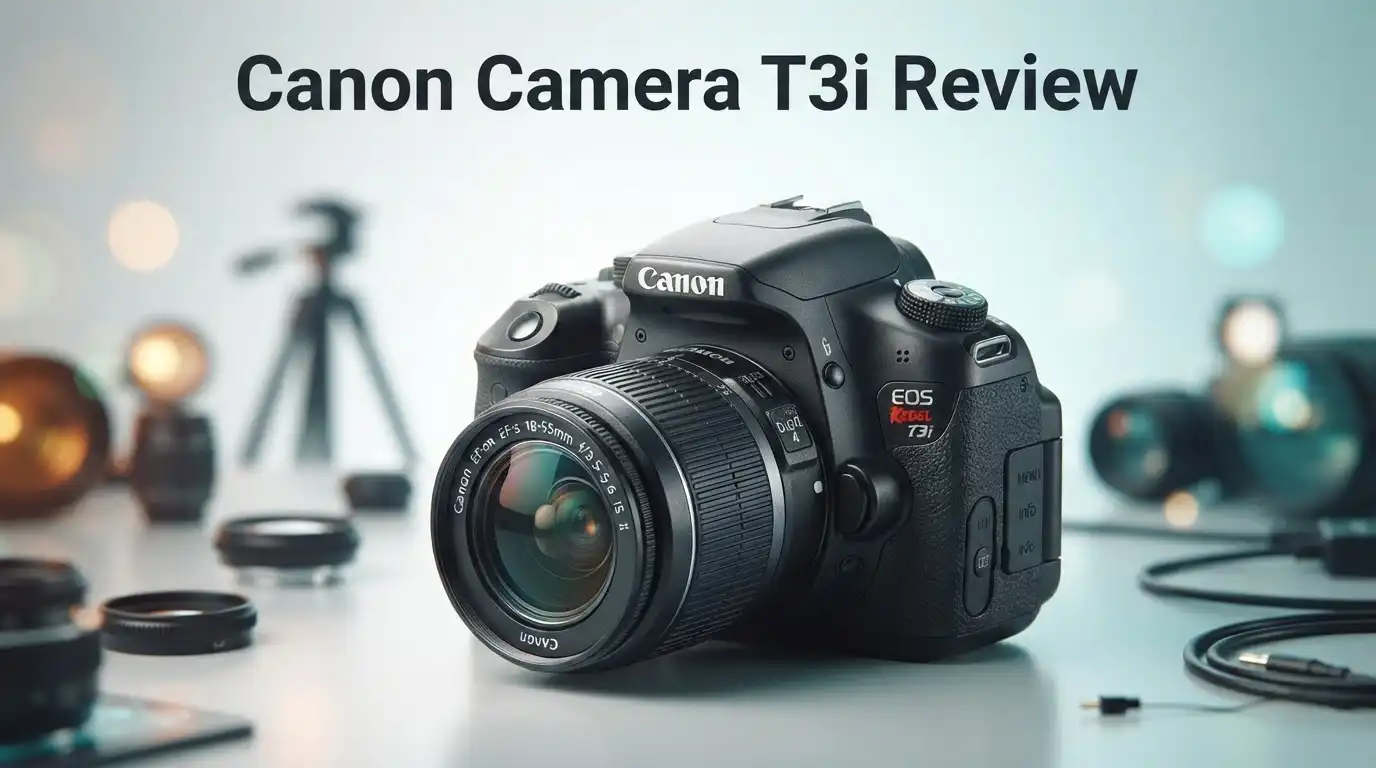
The Canon EOS Rebel T3i is an entry level DSLR. Canon sells it as the EOS 600D outside North America. It arrived in March 2011 with an $899 kit price. That same kit now trades on the used market for a fraction of the cost.
The core specs read like this. An 18 megapixel APS C CMOS sensor sits behind the mirror. A DIGIC 4 processor handles the files. ISO runs from 100 to 6400, with an expanded setting at 12800. The camera shoots 3.7 frames per second.
What made the T3i special in its day was the screen. Canon gave it a 3 inch vari angle LCD with 1.04 million dots. That was a big deal for an entry level body at the time.
The camera weighs about 570 grams with battery and card. It feels light but not flimsy.
Unboxing The Canon T3i In 2026
Buying used means the unboxing experience varies. My copy arrived in the original black and red Canon box, which was a nice surprise. Many sellers ship these in padded envelopes with no box at all.
Inside I found the body, a body cap, the LP E8 battery, a wall charger, a neck strap, and the 18 to 55mm IS II kit lens. The original software discs were still sealed. I threw those away immediately, since no modern computer reads them and the software is long outdated.
The first thing I noticed was the grip texture. Fifteen years of hands had worn it smooth in places. The second thing was the weight. This camera feels lighter than it looks.
I charged the battery for two hours, popped in a 32GB SD card, and started shooting. No setup app. No firmware download. No account login. It simply worked.
Design And Build Quality
The T3i uses a polycarbonate shell over a metal chassis. It does not feel premium. It also does not feel cheap. The plastic has a slight texture that resists fingerprints better than glossy finishes.
The grip fits medium hands well. People with large hands will find their pinky finger hanging off the bottom. A cheap battery grip solves this and adds shooting time.
Button layout follows the classic Rebel pattern. The mode dial sits on top right and spins freely with no lock. I knocked mine out of position several times inside a camera bag.
There is one control dial, not two. You change aperture in manual mode by holding the exposure compensation button and turning the dial. This slows you down, and it remains my biggest ergonomic complaint about the body.
Weather sealing does not exist here. Keep it dry.
Image Quality And The 18 Megapixel Sensor
This is where the T3i earns its keep. The 18 megapixel sensor was excellent in 2011 and remains respectable in 2026. Files measure 5184 by 3456 pixels, which prints well up to 16 by 20 inches.
Daylight shots look clean and detailed. Canon color science produces warm skin tones that need little correction. JPEGs straight from the camera often look better than files from budget mirrorless bodies.
ISO performance tells a mixed story. ISO 100 to 400 looks clean. ISO 800 shows mild grain that most people will accept. ISO 1600 gets noticeably noisy. ISO 3200 and above should be treated as emergency settings only.
Dynamic range sits around 11 stops. That trails modern sensors by two stops or more. Shadows turn muddy when you lift them hard in editing.
Shoot RAW. The extra recovery room matters on a sensor this age.
Top 3 Alternatives For Canon EOS Rebel T3i

- 24.1 Megapixel CMOS (APS-C) sensor with is 100–6400 (H: 12800)
- Built-in Wi-Fi and NFC technology

Some of the links on this website are affiliate links, which means that at no additional cost to you, I earn a commission if you click through and make a purchase. I only recommend products and services that I believe will add value to my readers. Thank you for your support!
Canon EOS Rebel T7 DSLR Camera

- Mounting type: Bayonet
- Turn your Canon camera into a high-quality webcam
Some of the links on this website are affiliate links, which means that at no additional cost to you, I earn a commission if you click through and make a purchase. I only recommend products and services that I believe will add value to my readers. Thank you for your support!
Canon EOS Rebel SL3 Digital SLR Camera

- 24.1 megapixel (aps-c) cmos sensor with iso 100-25600 (h: 51200).
- Digic 8 image processor with auto lighting optimizer.
Some of the links on this website are affiliate links, which means that at no additional cost to you, I earn a commission if you click through and make a purchase. I only recommend products and services that I believe will add value to my readers. Thank you for your support!
Canon EOS M50 Mark II Mirrorless Camera
Autofocus Performance In Real Use
The T3i uses a nine point autofocus system. Eight points sit around the edges. One cross type point sits in the center. That center point does most of the heavy lifting.
Through the viewfinder, focus acquisition feels quick in good light. Point at a face, half press, and it locks in under a second. Low light changes everything. In dim rooms the lens hunts back and forth before settling.
The focus points cluster tightly in the middle of the frame. Composing with a subject near the edge means focusing first, then recomposing. This habit becomes second nature, but it is still a limitation.
Live view autofocus is genuinely slow. The camera uses contrast detection through the screen. Expect two to three seconds per focus attempt. Modern phones focus faster than this camera does in live view.
Tracking moving subjects like kids or pets requires patience and burst shooting.
Video Features And Their Limits
The T3i records 1080p at 30, 25, and 24 frames per second. It also records 720p at 60 and 50 frames per second for slow motion. Files save as MOV using H.264 compression.
Video quality looks soft compared to modern cameras. The camera line skips when reading the sensor, which creates moire patterns on fabrics and brick walls. You will see this on striped shirts almost every time.
Here is the deal breaker for many buyers. The T3i has no continuous autofocus during video recording. You must focus manually while filming. Canon added movie servo autofocus with the T4i, one generation later.
Manual focus video is doable with practice. Use the vari angle screen, punch in with the magnify button, set focus, then record. It works for static interviews and product shots. It fails for moving subjects.
Recording caps at 29 minutes and 59 seconds per clip.
The Vari Angle Screen Advantage
The flip out screen remains the T3i’s best feature. It hinges on the left side, swings out 175 degrees, and rotates 270 degrees. You can face it forward, downward, or upward.
Low angle shots become easy. I photographed flowers at ground level without lying in mud. Overhead shots at crowded events worked the same way. This one feature changes how you shoot.
Content creators will appreciate flipping the screen forward to frame themselves. Remember that manual focus requirement though. You still cannot rely on the camera to track your face.
The screen folds inward against the body for protection. Used T3i screens often look pristine because of this design.
Resolution measures 1.04 million dots, which looks sharp enough for checking composition. It is not a touchscreen. Every setting change happens through buttons.
Battery Life And Storage
The LP E8 battery delivers roughly 440 shots per charge using the viewfinder. That number drops to about 180 shots when using live view heavily. Video recording drains it faster still.
Original Canon batteries from 2011 have degraded. Most used cameras ship with tired cells. Budget $20 for a pair of fresh third party batteries. They work fine and the camera reports their charge level.
Storage uses a single SD, SDHC, or SDXC card slot. The camera handles cards up to 128GB without issue in my testing. Speed requirements are modest since the buffer fills after about six RAW frames anyway.
An older camera with cheap batteries and cheap cards is part of the appeal. You are not paying premium prices for accessories like you would with newer bodies that use CFexpress.
Lens Options And The EF Mount
The T3i uses Canon’s EF and EF S mount. This is the single strongest reason to buy one. Decades of lenses fit this camera.
The kit 18 to 55mm IS II lens is adequate and nothing more. It is soft at the edges and slow in low light. Replace it when you can.
Start with the Canon EF 50mm f/1.8 STM. It costs around $125 new and transforms what this camera can do. The wide aperture fixes the low light weakness and creates genuine background blur.
The EF S 24mm f/2.8 STM pancake lens turns the T3i into a compact street camera. The EF S 55 to 250mm IS STM covers telephoto needs affordably.
Used EF glass floods the market right now because photographers are moving to mirrorless. You benefit from that shift.
What The Canon T3i Does Not Do Well
Honest reviews list the failures. Here they are plainly.
The camera has no Wi Fi and no Bluetooth. Moving photos to your phone requires an SD card reader or an Eye Fi style card. This annoyed me daily.
There is no touchscreen. Menu navigation happens through the four way pad, which feels slow after using any modern device.
High ISO performance disappoints. Indoor shots without flash above ISO 1600 look grainy and lose color depth.
The single control dial slows down manual shooting. Two dial cameras are simply faster.
Video autofocus does not exist during recording. Full stop.
Burst shooting at 3.7 frames per second cannot handle sports. The buffer fills after six RAW frames and then the camera stalls.
The viewfinder shows 95 percent coverage. Small elements sneak into frame edges without warning.
Pros And Cons Of The Canon T3i
Pros
- Excellent value at under $200 for a complete working kit
- Sharp 18 megapixel files that print well and edit nicely in RAW
- Fully articulating vari angle screen that helps with awkward angles
- Access to thousands of affordable EF and EF S lenses
- Warm, pleasing Canon color science straight out of camera
- Simple, logical controls that teach photography fundamentals well
- Lightweight body at 570 grams that travels easily
- Built in wireless flash controller for off camera lighting experiments
- Cheap batteries and standard SD cards keep running costs low
Cons
- No Wi Fi, Bluetooth, or any wireless image transfer
- No touchscreen anywhere in the interface
- No continuous autofocus while recording video
- Weak high ISO performance above ISO 1600
- Only nine autofocus points clustered in the center
- Slow contrast detection autofocus in live view mode
- Single control dial slows manual exposure adjustments
- No 4K video and no 60 frames per second at 1080p
- Aging batteries on most used copies
- No weather sealing of any kind
Who Should Buy The Canon T3i In 2026
This camera suits specific people very well. Beginners learning manual photography get the most value. The controls teach aperture, shutter speed, and ISO without hiding them behind automation.
Students on tight budgets should consider it seriously. A photography class kit under $250 leaves money for lenses and lighting.
Portrait and product photographers working in controlled light will be happy. Studio strobes and daylight eliminate the ISO weakness entirely.
Film style shooters who like slow, deliberate work will enjoy the manual focus discipline.
Who should skip it? Anyone shooting sports or wildlife needs better autofocus. Anyone creating video content needs autofocus during recording. Anyone who wants to post photos to Instagram within minutes needs wireless transfer.
Vloggers specifically should buy the M50 Mark II instead. The difference in usability is enormous.
Price And Buying Used Safely
Expect to pay $100 to $180 for a body only in good condition. Kits with the 18 to 55mm lens run $150 to $220. Prices have stayed flat for three years now.
Check the shutter count before buying. The T3i is rated for roughly 100,000 actuations. Anything under 30,000 counts as low mileage. Sellers can read this number using free software.
Inspect the sensor for dust and scratches. Ask for a photo of a plain white wall shot at f/16. Dust spots show clearly in that test.
Test the mode dial, the pop up flash, and every button. Look for fungus inside any bundled lens.
Buy from sellers who accept returns. Amazon Renewed listings and reputable camera stores offer better protection than random marketplace sellers.
Final Verdict On The Canon T3i
The Canon EOS Rebel T3i in 2026 is a bargain with conditions attached. It takes genuinely good photographs. It teaches photography properly. It opens the door to an enormous lens ecosystem for very little money.
It also feels its age in ways you cannot ignore. No wireless. No touchscreen. No video autofocus. Modest low light performance.
My recommendation is simple. Buy the T3i if you want to learn photography cheaply and you are willing to work around its limits. Spend the savings on a 50mm f/1.8 lens and a tripod.
Do not buy it if you want a camera that keeps up with your phone for convenience. Your phone wins that fight easily.
For under $200, the T3i still delivers more creative control than anything else at that price. That is a real achievement for a camera built fifteen years ago.
Frequently Asked Questions
Is the Canon T3i still good in 2026?
Yes, for stills photography and learning. The 18 megapixel sensor produces sharp, printable images in good light. It struggles in low light and lacks modern conveniences like Wi Fi and touchscreen control.
Can the Canon T3i shoot 4K video?
No. The T3i records 1080p at a maximum of 30 frames per second. It also offers 720p at 60 frames per second. There is no 4K option and no firmware update adds it.
Does the Canon T3i have autofocus during video?
No. You must focus manually while recording. Canon introduced movie servo autofocus with the T4i, the next model in the line.
How much should I pay for a used Canon T3i?
Body only copies sell for $100 to $180. Complete kits with the 18 to 55mm lens run $150 to $220. Check the shutter count and request return protection before buying.
What is the best lens for the Canon T3i?
The Canon EF 50mm f/1.8 STM offers the biggest upgrade for around $125. It improves low light shooting and creates soft background blur. The EF S 24mm f/2.8 STM suits street photography.
Does the Canon T3i have Wi Fi?
No. The camera has no wireless features at all. Transfer photos using an SD card reader or a USB cable connected to a computer.
Is the Canon T3i good for beginners?
Yes. The control layout, guided shooting modes, and flip out screen make learning straightforward. The low used price also means mistakes cost very little.

Welcome to The File Fix. I’m Millie, and I review tech so you don’t have to suffer buyer’s remorse.
Navigating the endless sea of Amazon devices and gadget releases can feel like a full-time job. That’s why I do the heavy lifting. I dig past the unreliable 5-star reviews and shiny spec sheets to test how these devices actually hold up in the real world. Whether you’re looking for the best budget earbuds, a reliable power bank, or the latest smart home gear, you’ll find honest, no-nonsense breakdowns here.