Why Is My Smart Blinds Motor Making A Grinding Noise?
Your smart blinds glide up and down with one tap. They feel like magic. Then one day, that smooth glide turns into an ugly grinding sound. Your stomach drops. You wonder if the motor is dying. You wonder if you broke something expensive.
Take a breath. A grinding noise is a warning sign, not a death sentence. Most grinding problems come from simple causes like debris, loose parts, dry gears, or fabric stuck somewhere it should not be. Many of these you can fix yourself in under an hour.
This guide walks you through every common reason your smart blinds motor grinds. You get clear steps for each fix. You get the pros and cons of each method.
In a Nutshell:
- Grinding usually means a mechanical problem, not a dead motor. The most common culprits are worn gears, trapped debris, dry moving parts, or fabric that has slipped or jammed inside the roller tube.
- Always cut the power before you touch anything. Disconnect the battery pack or unplug the adapter first. This keeps you safe and stops the motor from grinding itself into worse damage.
- Cleaning and lubrication fix a huge share of grinding noises. A soft brush, compressed air, and a silicone based spray solve many problems for just a few dollars.
- Loose mounting brackets are a sneaky cause. When brackets vibrate, the noise sounds like grinding even when the gears are fine. Tighten every screw before you assume the worst.
- Never force the blinds by hand to fix them. Pulling motorized blinds manually can strip the internal gears and turn a small problem into a full motor replacement.
- Know your limits. Battery swaps, cleaning, and recalibration are safe DIY jobs. Internal gear repair, motor replacement, and wiring faults belong to a qualified technician.
What A Grinding Noise From Your Smart Blinds Actually Means
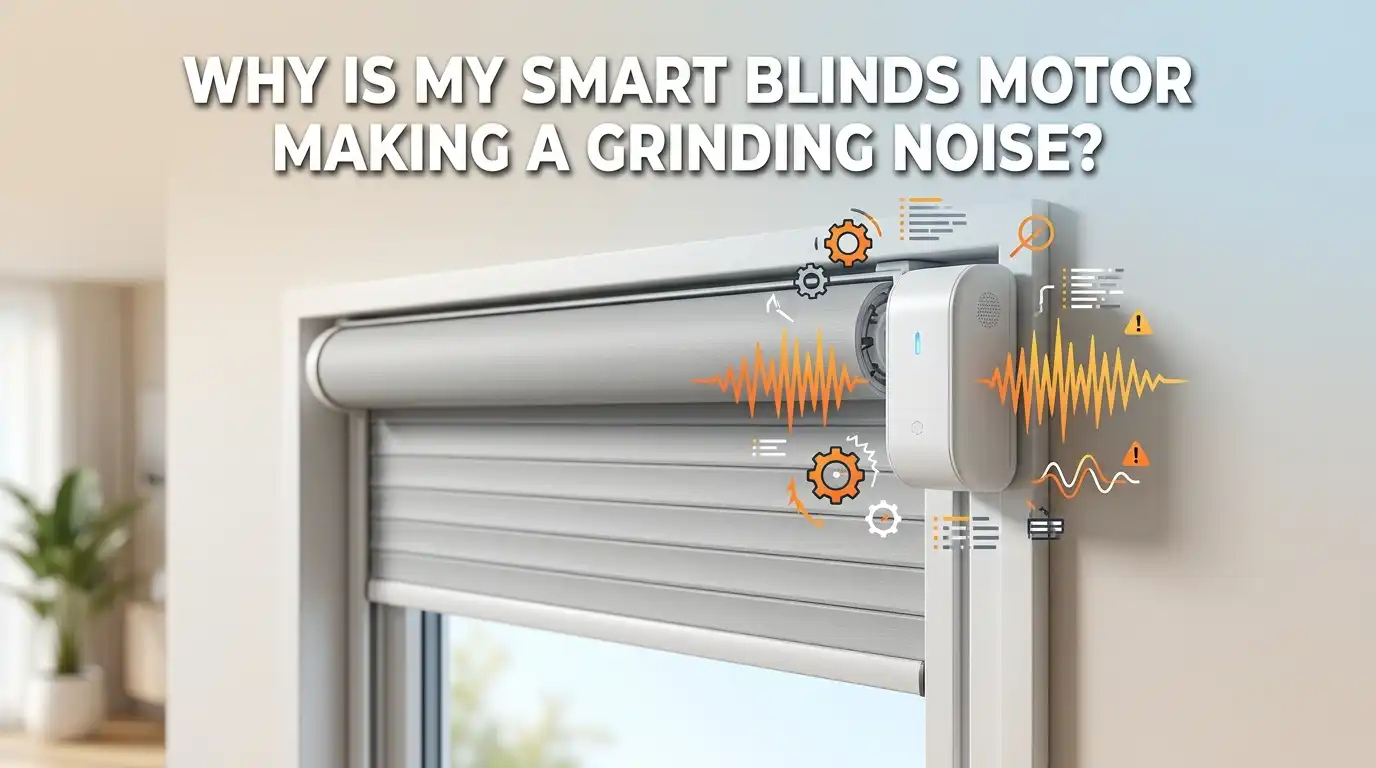
A grinding noise tells you that two parts are rubbing when they should be moving smoothly. This is different from a normal hum. A healthy smart blinds motor makes a soft, steady whirring sound. Grinding is rough, harsh, and uneven.
The sound points to a mechanical issue in most cases. The gears inside the motor head may be worn. Debris may have fallen into the mechanism. The fabric may be catching on the roller tube. Sometimes a loose bracket vibrates and mimics a grinding sound.
Think of the noise as your blinds asking for help. The grinding rarely starts on its own. It usually builds slowly as parts wear or dirt collects. The good news is that catching it early gives you the best chance of a cheap, simple fix instead of a costly replacement.
Cut The Power Before You Start Any Repair
Safety comes first, always. Before you inspect or fix anything, you must cut the power to your smart blinds. This protects you and protects the motor.
For battery powered blinds, remove the battery pack or take out the batteries. For hardwired blinds, unplug the adapter from the wall. If your blinds connect to a circuit, switch off the breaker that controls them. Confirm the blinds will not respond to the remote or app before you continue.
Cutting power does two important things. First, it stops you from accidentally running the motor while your fingers are near moving parts. Second, it prevents the motor from grinding itself into worse damage while you work.
The downside is small but real. You will need to recalibrate the limits after you restore power. That trade is worth it. A few minutes of reprogramming beats a hospital trip or a ruined motor every single time.
Check For Debris Stuck In The Mechanism
Dust, dirt, and small objects love to hide inside blind mechanisms. Over time they build up and jam the moving parts. This is one of the most common and easiest grinding causes to fix.
Start by looking closely at the roller tube, the motor head, and the brackets. Use a flashlight. Look for clumps of dust, hair, dead insects, or anything that does not belong. Even a tiny piece of grit can create a loud grinding sound.
To clean it out, use a soft brush or a can of compressed air. Blow or sweep the debris away from the gears and tracks. Wipe surfaces with a slightly damp cloth, then dry them fully before you restore power.
Pros: This method is cheap, fast, and totally safe for beginners. It often solves the problem completely.
Cons: It only works if debris is the real cause. If the gears are already worn, cleaning will quiet the noise for a short time but not fix the root issue.
Inspect The Fabric And Roller For Jams
Smart blinds rely on fabric rolling evenly around a tube. When that fabric slips, bunches, or catches, the motor strains and grinds. This happens a lot after the blinds get stuck halfway.
Look at how the fabric sits on the roller tube. Check whether one side hangs lower than the other. Look for folds, wrinkles, or fabric wrapping unevenly. Uneven fabric forces the motor to work harder and creates that grinding sound.
To fix a mild case, run the blind fully down, then fully up once. This sometimes lets the fabric realign on its own. If the fabric stays uneven, you may need to remove the blind from its brackets and rewrap it by hand.
Pros: Realigning fabric often fixes grinding without any tools or cost.
Cons: Severe fabric slips are tricky. Removing and rewrapping the blind takes care and patience. If you do it wrong, you can make the alignment worse, so a pro may be the safer choice here.
Tighten Loose Mounting Brackets And Hardware
Loose hardware is a sneaky troublemaker. When brackets, screws, or the headrail vibrate during operation, the rattling can sound exactly like grinding. Many people replace a motor when all they needed was a screwdriver.
Check every mounting point. Press gently on the headrail and watch for movement. Wiggle the brackets. Look for any screw that has worked itself loose over months of daily use.
Grab a screwdriver and tighten each screw firmly. Do not overtighten, since that can crack plastic parts or strip the threads. Check the brackets where they attach to the wall or window frame too, because that is a common loose spot.
Pros: This fix costs nothing, takes minutes, and removes a frequent cause of fake grinding noises.
Cons: It will not help if the noise comes from inside the motor. Tightening hardware is a great first step, but it only solves problems caused by vibration and loose mounting, not worn internal gears.
Lubricate The Moving Parts The Right Way
Dry gears and tracks create friction, and friction creates grinding. A good lubricant restores smooth movement. This is one of the most satisfying fixes because the noise often vanishes instantly.
Use a silicone based spray for blind mechanisms. Avoid oil based products like WD40 on the fabric or near electronics, since they attract dust and can stain. Apply a light mist to the moving parts, the tracks, and the visible gears. Wipe away any excess.
Keep the spray well away from the motor’s electrical parts. A little goes a long way here. Run the blinds a few times after applying so the lubricant spreads evenly across the moving surfaces.
Pros: Lubrication is cheap, quick, and works wonders on dry or stiff mechanisms.
Cons: It is a treatment, not always a cure. If your gears are physically worn down, lubricant only masks the grinding for a while. You will hear the noise return as the worn parts keep wearing.
Examine The Gears For Wear And Damage
If cleaning, tightening, and lubricating do not stop the noise, the internal gears may be worn. Worn gears are the most serious common cause of grinding. This is the heart of the motor’s mechanical system.
Gears wear down from years of use, from forcing the blinds by hand, or from running the motor against an obstruction. Worn teeth no longer mesh cleanly, so they grind against each other every time the motor turns.
To check, you may need to remove the motor head cover, if your model allows it. Look at the gear teeth for rounding, cracks, or missing pieces. If you see damage, the gears or the whole motor unit will likely need replacement.
Pros: Spotting worn gears early helps you decide between repair and replacement before the motor fails completely.
Cons: Gear repair is not a beginner job. Opening the motor can void your warranty and risks more damage. For most people, this is the point to call a professional.
Reset And Recalibrate Your Smart Blinds Motor
Sometimes the grinding comes from incorrect limit settings. When the motor does not know where to stop, it can push past the safe range and grind. A reset and recalibration often fixes this.
To reset, cut the power for five to ten seconds, then restore it. Many models reset by power cycling two or three times in a row. Watch for a small movement or an LED flash to confirm the reset worked.
After the reset, reprogram the upper and lower limits. Run the blind to the fully open position and set the top limit. Move it to the fully closed position and set the bottom limit. Test a few full cycles to confirm smooth, quiet movement.
Pros: Recalibration is free, safe, and fixes grinding caused by limit errors or calibration drift after a power outage.
Cons: A reset wipes your saved settings and smart home connections. You will need to reprogram everything, including schedules and app pairings, which takes a little extra time.
Check The Power Source And Battery Health
Weak power can cause strange motor behavior, including straining and grinding sounds. A motor that does not get enough power struggles to turn smoothly. This is an easy thing to rule out early.
For battery powered blinds, replace the batteries or recharge the battery pack fully. Look for white or greenish corrosion around the battery contacts and clean it off. Even new batteries can be weak, so use fresh, quality ones.
For hardwired blinds, confirm the adapter is fully plugged in and the outlet works. Test the outlet with another device. Inspect the adapter cable for damage, kinks, or loose connections.
Pros: This check is simple and cheap, and it rules out a common hidden cause of motor strain.
Cons: Power is rarely the sole cause of true grinding. A failing battery usually causes weak or stop start movement before it causes grinding, so do not stop here if the noise continues with fresh power.
Look For Obstructions Around The Blinds
An object blocking the blind’s path forces the motor to grind against the resistance. This cause is easy to overlook because the blockage is often outside the mechanism. A quick visual check saves a lot of worry.
Walk up to your blinds and look at the full range of motion. Check whether furniture, a plant, a curtain, or a window handle blocks the path. Look for anything that fell behind the blind or got wedged near the roller.
Remove any obstruction you find. Make sure the window frame has not shifted from weather or house settling, since a warped frame can rub against the blind. Confirm nothing leans against the headrail.
Pros: Clearing obstructions is instant and free, and it prevents the motor from straining and wearing out faster.
Cons: This fix is situational. If nothing blocks the blinds, you can rule it out quickly, but it will not help when the grinding comes from inside the motor or gears.
Know When To Repair Versus Replace The Motor
At some point you must decide whether to fix the motor or replace it. This choice depends on the cause, the cost, and the age of your blinds. Making the right call saves money and frustration.
Repair makes sense when the problem is debris, loose hardware, dry gears, fabric jams, or calibration. These fixes are cheap and fast. Replacement makes more sense when the motor overheats, grinds even after every fix, or fails to respond after a reset.
Compare costs honestly. If repeated repairs on an old motor start to approach the price of a new unit, replacement is the smarter long term choice. Newer motors also come with fresh warranties.
Pros of repair: Lower upfront cost and you keep your existing setup.
Cons of repair: Repeated repairs on a worn motor waste money over time.
Pros of replacement: Reliable operation and warranty coverage.
Cons of replacement: Higher cost and the effort of installing and reprogramming a new unit.
When To Call A Professional Technician
Some grinding problems are beyond a safe DIY fix. Knowing when to step back protects your safety, your warranty, and your wallet. There is no shame in calling for help.
Call a professional when you smell burning, see sparks, or notice smoke near the motor. These signs point to an electrical fault that you should never touch yourself. Also call when the motor needs internal gear repair or full replacement.
A qualified technician has the right tools and parts. They can diagnose faults that are hard to see. They also avoid voiding your warranty, which can happen if you open the motor yourself.
Pros: Professional service is safe, accurate, and often covered under warranty. It saves you from making the problem worse.
Cons: It costs more than a DIY fix and you may wait for an appointment. For complex or electrical issues, though, that cost buys peace of mind and a proper repair.
How To Prevent Grinding Noises In The Future
Prevention beats repair every time. A little routine care keeps your smart blinds quiet and extends the motor’s life. Good habits stop most grinding noises before they ever start.
Clean the tracks and roller tube every month with a soft brush. Replace batteries before they fully drain, since weak power strains the motor. Never pull the blinds by hand, because forcing them strips the internal gears fast.
Recalibrate the limits after any power outage or long period of no use. Update your app and firmware when new versions arrive. Avoid sending rapid, repeated commands, since that overworks the motor and wears the gears.
Pros: Regular maintenance is cheap, easy, and prevents expensive repairs down the road.
Cons: It takes a small, ongoing time commitment. You have to remember to do the tasks, but a few minutes each month saves you from a grinding motor and a big repair bill.
Frequently Asked Questions
Is a grinding noise from my smart blinds dangerous?
A grinding noise is not usually dangerous to you, but it signals a mechanical problem. Ignoring it can lead to worse damage or full motor failure. If you smell burning or see smoke, cut the power right away and call a professional, since that points to an electrical fault.
Can I use WD40 to stop my smart blinds from grinding?
It is better to use a silicone based spray instead of WD40. Oil based products attract dust and can stain the fabric or harm the electronics. Silicone spray lubricates the moving parts cleanly and lasts longer without creating a sticky mess that makes the grinding return.
Why do my smart blinds grind only when going up?
Grinding only on the way up often points to incorrect upper limit settings, a fabric jam, or the motor’s safety protection kicking in. The motor strains against extra resistance as it lifts the weight. Try recalibrating the limits and checking the fabric path for any catching or binding.
Will forcing my blinds by hand fix the grinding?
No, never pull motorized blinds by hand. Forcing them can strip the internal gears and permanently break the motor. It can also void your warranty. Always operate your smart blinds with the remote, wall switch, or app, even when you are trying to free a small jam.
How much does it cost to fix a grinding smart blinds motor?
The cost depends on the cause. Cleaning, tightening, and lubricating cost only a few dollars in supplies. A full motor replacement costs much more, often a large share of the blind’s original price. Always try the cheap DIY fixes first before paying for a new motor.
How often should I maintain my smart blinds to avoid grinding?
Aim for a quick clean and check every month, with a deeper inspection every few months. Regular care removes debris and catches loose hardware early. Replace batteries before they fully drain and recalibrate after power outages. This simple routine keeps the motor quiet and running smoothly for years.