How To Fix Teleprompter App Text Scrolling Stutter On Android Tablets?
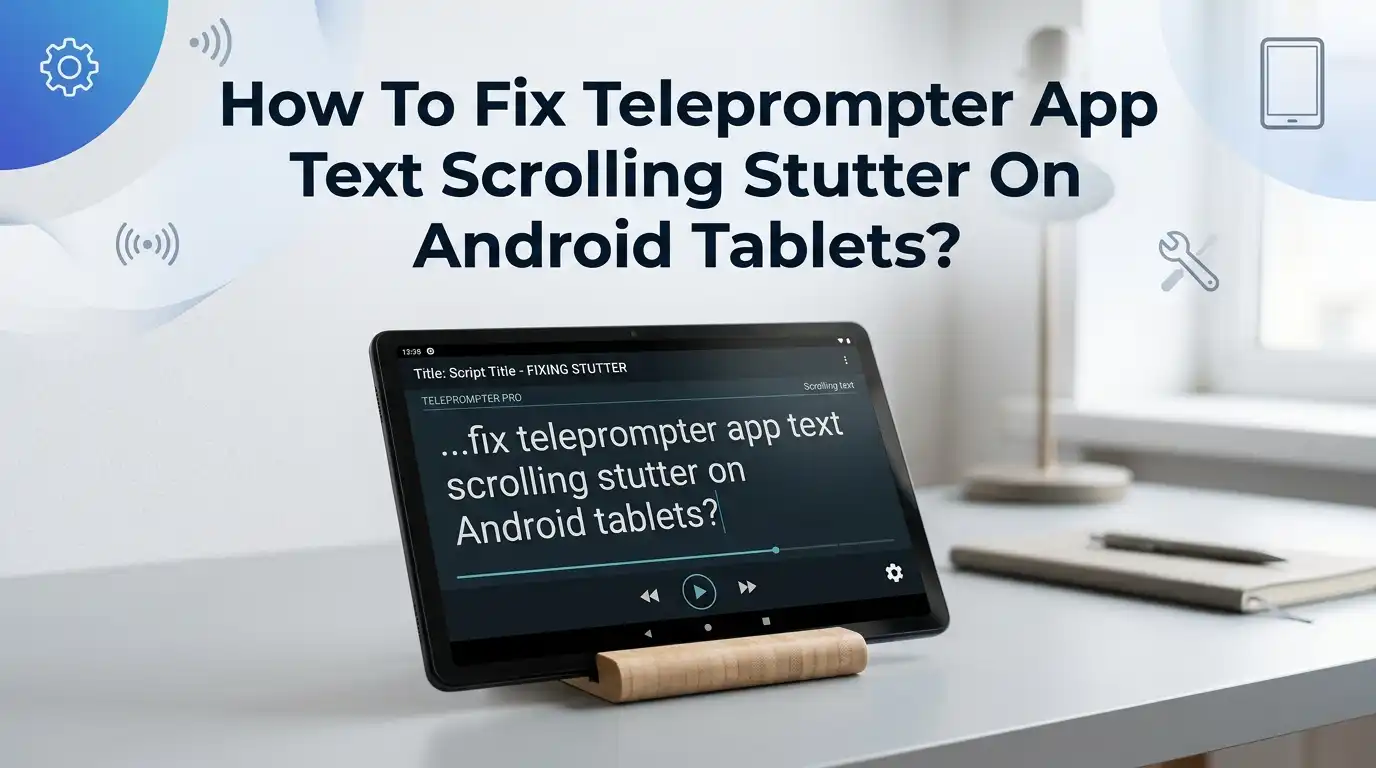
You set up your camera. You open your teleprompter app. You hit play. Then the text jerks across the screen like a slideshow instead of flowing smoothly. That stutter ruins your reading rhythm and your recording. If this sounds familiar, you are in the right place.
Scrolling stutter on Android tablets is one of the most common teleprompter complaints. The good news is that most of it comes from fixable causes. Background apps, low refresh rates, battery throttling, and heavy text settings all play a part. You do not need a new tablet to solve this.
This guide walks you through every practical fix in plain steps. You will learn what causes the lag and how to stop it for good. By the end, your text will glide smoothly while you read like a pro.
Key Takeaways
- Background apps are the biggest culprit. Closing them and freeing RAM gives your teleprompter app the resources it needs to scroll smoothly without dropping frames.
- Refresh rate settings matter more than people think. Forcing your tablet to use its highest refresh rate, like 90Hz or 120Hz, makes scrolling text look noticeably smoother and easier to read.
- Battery optimization quietly throttles your app. Setting your teleprompter app to “Unrestricted” stops Android from slowing it down mid recording.
- Developer Options give you powerful control. Adjusting animation scale and forcing GPU rendering can reduce stutter on older or budget tablets.
- Heavy text settings strain weak hardware. Lowering font size, mirror effects, and shadow effects lightens the load and keeps frames steady.
- Software updates and cache clearing fix hidden bugs. Keeping your tablet and app current removes glitches that cause random stutter during long reads.
Why Does Teleprompter Text Stutter On Android Tablets?
Before you fix the problem, you should understand what causes it. Stutter happens when your tablet cannot draw new frames fast enough. The text moves in jumps instead of a smooth glide because frames get dropped.
Several things trigger this. Your tablet may run low on free memory. Background apps eat the processing power your teleprompter needs. Your screen refresh rate may sit too low for fluid motion.
Some tablets also throttle apps to save battery. This slows the scroll engine mid use. Heavy visual settings like large fonts, shadows, and mirror flips add extra rendering work too.
On budget tablets, weaker processors and GPUs simply struggle with constant motion. Knowing the cause helps you pick the right fix. The sections below address each one in order, from easiest to most technical.
Restart Your Tablet Before Anything Else
This sounds basic, but it works more often than you expect. A restart clears temporary memory and stops stuck background processes. Many stutter problems vanish after a simple reboot.
Your tablet builds up cached data and idle apps over days of use. These quietly drain resources your teleprompter app needs. A fresh start gives the app a clean slate to run on.
To do it, hold the power button. Tap “Restart” or “Reboot.” Wait for the tablet to fully load before opening your teleprompter app again.
Pros: It takes under a minute. It needs no technical skill. It fixes many random glitches instantly.
Cons: The effect is temporary. If a deeper cause exists, the stutter returns after heavy use. You will need the later fixes for a lasting solution. Still, always try this first.
Close Background Apps To Free Up Memory
Background apps are the number one reason teleprompter scrolling stutters. Each open app uses RAM and processing power your teleprompter could be using. Closing them frees those resources right away.
Open your recent apps view by swiping up and holding, or tapping the square button. Swipe away every app you do not need. Tap “Close all” if your tablet offers it.
Pay special attention to heavy apps. Browsers, social media, video apps, and games drain the most power. Close these before every teleprompter session for the best results.
Some Samsung tablets include a “Device care” tool. Open it and tap “Optimize now” to clear memory in one step.
Pros: It directly boosts smoothness. It is fast and free. It works on every Android tablet.
Cons: Apps may reopen on their own. You must repeat this before each session. It will not fix hardware limits on very old tablets.
Force A Higher Refresh Rate For Smoother Scrolling
Refresh rate controls how many times your screen updates per second. A higher refresh rate makes moving text look far smoother. Many tablets default to 60Hz even when they support 90Hz or 120Hz.
Go to Settings, then “Display.” Look for “Motion smoothness,” “Refresh rate,” or “Smooth display.” Select the highest option your tablet offers.
If your tablet uses adaptive refresh rate, it may drop to 60Hz during reading to save battery. To stop this, enable Developer Options and turn on “Force peak refresh rate.” This keeps the screen at its top speed.
Pros: It creates an instant visual improvement. Text glides instead of stepping across the screen. It needs no extra apps.
Cons: Higher refresh rates use more battery. Budget tablets may only support 60Hz, so this fix will not apply. Keep your charger nearby during long shoots.
Turn Off Battery Optimization For Your Teleprompter App
Android often throttles apps to save power. This throttling can slow your teleprompter mid scroll and cause sudden stutter. Telling Android to leave your app alone solves this.
Go to Settings, then “Apps.” Tap your teleprompter app. Open “Battery” and select “Unrestricted” or “Don’t optimize.” This stops the system from limiting the app’s resources.
The exact wording changes by brand. On Samsung, look under “Battery” inside the app settings. On Pixel tablets, find “Battery optimization” and switch the app to “Unrestricted.”
Pros: It prevents random slowdowns during recording. It keeps performance steady from start to finish. The setting stays until you change it.
Cons: The app may use slightly more battery in the background. This is a fair trade for smooth scrolling. It only affects that one app, so the impact stays small.
Lower Your Font Size And Visual Effects
Heavy text settings make your tablet work harder. Large fonts, shadows, glow effects, and mirror flips all add rendering load. Reducing them lightens the work and steadies your frame rate.
Open your teleprompter app settings. Lower the font size a little if your script still stays readable. Turn off any drop shadow, outline, or glow effects you do not need.
If you do not use a beam splitter glass setup, turn off mirror mode. The horizontal flip adds extra processing on each frame. Simpler text means smoother motion on weaker tablets.
Pros: It directly reduces stutter on budget devices. It costs nothing and applies instantly. You control exactly which effects to keep.
Cons: You may sacrifice some visual style. Very small fonts can be hard to read from a distance. Find a balance between readability and smoothness through quick testing.
Adjust Animation Scale In Developer Options
Android animations affect how motion feels across your tablet. Reducing the animation scale can make scrolling feel faster and smoother. This is a hidden but powerful fix.
First, enable Developer Options. Go to Settings, then “About tablet,” and tap “Build number” seven times. You will see a message saying you are now a developer.
Go back to Settings and open “Developer options.” Find three settings: “Window animation scale,” “Transition animation scale,” and “Animator duration scale.” Set each one to 0.5x. This speeds up motion and can ease stutter.
Pros: It makes the whole tablet feel snappier. It helps older and budget tablets the most. The change is easy to reverse.
Cons: Some apps depend on animations and may behave oddly. Setting these to “off” entirely can cause visual glitches. Stick to 0.5x for the safest result.
Enable Force GPU Rendering For Better Performance
Your tablet has two main processors for visuals. The CPU handles general tasks. The GPU handles graphics. Force GPU rendering shifts drawing work to the GPU, which can smooth out scrolling.
Open “Developer options” again. Scroll to the “Hardware accelerated rendering” section. Find “Force GPU rendering” and turn it on.
This makes apps use the GPU to draw 2D elements like text and buttons. On many tablets, this reduces the load on the CPU and helps text scroll without dropping frames. Restart your teleprompter app after enabling it to apply the change.
Pros: It can boost smoothness in apps that do not use the GPU by default. It helps with constant scrolling motion. The toggle is simple.
Cons: It may slightly increase battery use and heat. On some newer tablets it makes little difference, since apps already use the GPU. Test before and after to see if it helps yours.
Clear The App Cache And Storage Space
Cached data builds up over time and can cause apps to misbehave. A bloated cache or near full storage can trigger stutter and slow performance. Clearing space gives your tablet room to run.
Go to Settings, then “Apps.” Tap your teleprompter app. Open “Storage” and tap “Clear cache.” This removes temporary files without deleting your scripts.
Next, check your overall storage. Go to Settings, then “Storage.” If your tablet is nearly full, delete unused apps, old videos, and downloads. Aim to keep at least 15 to 20 percent of your storage free.
Pros: It removes hidden glitches. Free storage helps your whole tablet run faster. Clearing cache is safe and keeps your data.
Cons: The cache rebuilds over time, so repeat it occasionally. Clearing app data, unlike cache, will erase settings, so avoid that unless needed.
Keep Your App And Android System Updated
Outdated software causes bugs that lead to stutter. Developers fix performance problems through regular updates. Running old versions means you miss those fixes.
Open the Play Store. Tap your profile icon, then “Manage apps and device.” Update your teleprompter app if an update waits. Updated apps often include scroll engine improvements.
Now check your system. Go to Settings, then “System,” then “Software update.” Download and install any available update. A fresh Android version can fix display and rendering bugs that cause lag.
Pros: It fixes known stutter bugs directly. It improves overall stability and speed. Updates are free and official.
Cons: Updates take time and need a charged battery. On rare occasions, a new update introduces fresh bugs. If that happens, report it to the app developer and wait for the next patch.
Switch To A Lighter Or Better Optimized Teleprompter App
Not all teleprompter apps are built the same. Some apps use smooth, well coded scroll engines while others jerk and stutter. If one app lags badly, another may run perfectly on the same tablet.
Many users report that certain apps scroll in pixel steps instead of smooth motion. This is a coding choice, not always a tablet fault. Look for apps that promise smooth or hardware accelerated scrolling.
Test a few free versions before you commit. Run the same script on each one and compare how the text moves. Pick the app that feels smoothest on your specific tablet.
Pros: It can solve stutter that no setting fixes. You find an app suited to your hardware. Many options exist for free.
Cons: Switching apps means relearning controls. You may need to re import your scripts. Some smoother apps lock features behind a paid version.
Reduce Scroll Speed And Use Voice Controlled Scrolling
Sometimes the stutter is tied to how fast you scroll. Very high scroll speeds force the tablet to draw frames faster than it can handle. Slowing the speed often smooths the motion.
Open your scroll speed control. Lower it gradually and watch how the text moves. A slightly slower, steady scroll beats a fast, jerky one. Adjust the font size so you still read comfortably.
Many apps also offer voice controlled scrolling. The text follows your speech instead of a fixed timer. This matches your natural pace and can feel smoother than manual speed settings.
Pros: It removes the strain of fast frame drawing. Voice scrolling keeps your reading natural. It works well for long scripts.
Cons: Voice scrolling needs a quiet room and clear speech. Background noise can confuse it. Slower scroll speeds mean you must read at a steady, controlled pace.
Free Up RAM With Built In Device Care Tools
Many Android tablets include tools to manage memory. These tools close idle apps and free RAM in one tap. They give your teleprompter app the breathing room it needs.
On Samsung tablets, open “Device care” in Settings. Tap “Memory,” then “Clean now.” This clears background processes draining your RAM. Some brands call this “Storage cleaner” or “Phone manager.”
For best results, run this tool right before recording. A clean memory pool helps the scroll engine run without interruption. Repeat it once a week to keep your tablet in good shape.
Pros: It frees resources quickly. It needs no third party apps. The built in tool is safe and brand approved.
Cons: The effect fades as apps reopen. Frequent cleaning gives diminishing returns. On very old tablets, it helps less because the hardware itself is the limit.
Test In Airplane Mode To Stop Background Interruptions
Network activity can cause sudden stutter during reading. Notifications, syncing apps, and downloads steal processing power at random moments. Cutting them off helps the scroll stay smooth.
If you do not need the internet while reading, turn on airplane mode. Swipe down from the top and tap the airplane icon. This blocks calls, messages, and background syncing instantly.
Some teleprompter apps need the internet for cloud scripts. In that case, load your script first, then switch to airplane mode before recording. This keeps your text ready while stopping interruptions.
Pros: It removes random stutter from notifications. It saves battery during recording. It is a quick one tap action.
Cons: You lose internet access while it is on. Voice scrolling that relies on cloud processing may not work. Remember to turn it off after your session ends.
Frequently Asked Questions
Why does my teleprompter text stutter only on long scripts?
Long scripts use more memory and keep the scroll engine running longer. Over time, your tablet may run low on free RAM. Clearing background apps and freeing memory before recording usually fixes this. A restart before long sessions also helps a lot.
Will a higher refresh rate drain my tablet battery fast?
Yes, a higher refresh rate uses more power because the screen updates more often. The trade is worth it for smooth scrolling, though. Keep your charger connected during long recordings. You can switch the refresh rate back to normal for everyday use.
Does Force GPU rendering work on every Android tablet?
No, results vary by tablet. Older and budget tablets often see the biggest improvement. Many newer tablets already use the GPU by default, so the change does little. Test your scrolling before and after to see if it helps your device.
Can a budget tablet ever scroll teleprompter text smoothly?
Yes, with the right settings. Lower your font size, turn off heavy effects, and reduce scroll speed. Close all background apps and free your RAM first. A well optimized app on a clean, updated tablet can scroll smoothly even on modest hardware.
Is it safe to change Developer Options settings?
The animation scale and Force GPU rendering settings are safe to change. They are easy to reverse if something feels off. Avoid changing settings you do not understand. Stick to the ones in this guide, and you will stay on the safe side.
Should I uninstall and reinstall my teleprompter app?
A clean reinstall can fix deep glitches that cache clearing misses. Back up or note your scripts first, since reinstalling may erase them. After reinstalling, update the app right away and reapply your settings. This often restores smooth performance.