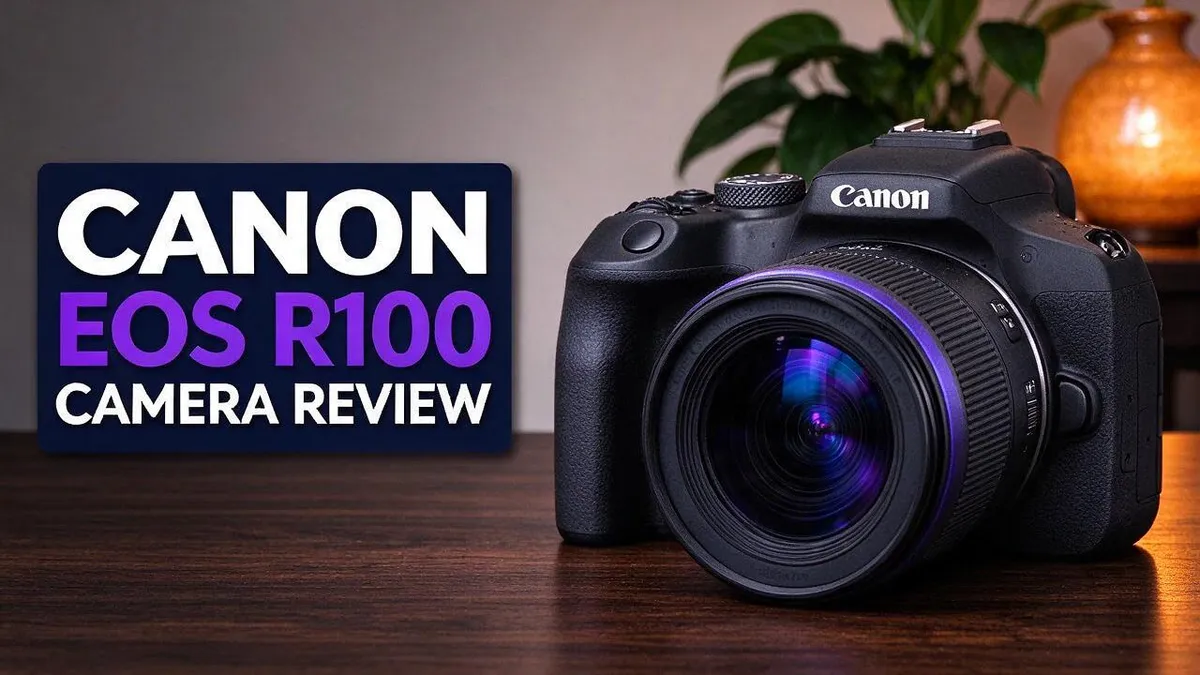
Canon EOS R100 Review: Everything You Need to Know
Are you looking for a small camera that takes sharp, colorful photos? The Canon EOS R100 might be the right fit for you. It opens the door to the Canon RF system without a big commitment.
Canon announced this camera on May 24, 2023. It packs a 24.1 MP sensor and a DIGIC 8 processor into a compact body. Photos look bright and detailed, and the colors feel natural.
Autofocus stays quick thanks to Dual Pixel CMOS AF. You can shoot up to 6.5 frames per second, which helps when action happens fast.
Video fans should know the limits. 4K recording runs only at 25 fps and uses a heavy crop. Still, 1080 video works well for everyday clips.
Stay with me as we look at the design, performance, and real world use. By the end, you will know if this camera suits your needs.
In a Nutshell
-
A friendly doorway into Canon mirrorless: This body lets new users enter the EOS R system and grow their lens collection over time. Each new lens works with the same mount, so the setup can expand step by step.
-
Colors that look great straight out of camera: Canon’s color science gives photos a natural, pleasing look. You spend less time editing and more time enjoying your shots.
-
Light enough to carry everywhere: The compact body fits easily in a bag. It works well for travel, family outings, and daily walks when you want a camera that never feels heavy.
-
A strong first camera pick: Reviewers often suggest it to beginners because the controls stay simple to learn. You can focus on framing and light instead of memorizing complicated settings.
-
Clear compromises to weigh: Missing image stabilization and a fixed screen mean you must hold steady and frame shots from the back. Careful technique matters more here than on models with extra features.
-
Crop changes your lens reach: The smaller sensor makes lenses act longer than their listed focal length. This helps with wildlife and sports, but it limits wide views for landscapes and interiors.
Image Quality and Color Science

- Beginner-Friendly Mirrorless Power: The Canon EOS R100 offers an accessible entry into mirrorless photography with a 24.1MP APS-C CMOS sensor and DIGIC 8 image processor, delivering vibrant, detailed images and smooth video. Designed for everyday shooters and first-time DSLR users, this compact camera balances quality and ease-of-use, providing auto scene modes and simplified menu navigation for a seamless learning curve.
- Versatile RF-S 18-45mm Lens Included: This kit comes with the Canon RF-S 18-45mm f/4.5-6.3 IS STM lens, perfect for general-purpose shooting. From family portraits and daily snapshots to travel landscapes and vlogs, this zoom lens delivers sharp results and smooth autofocus. Built-in image stabilization helps reduce shake, making handheld photography more stable and enjoyable.
Some of the links on this website are affiliate links, which means that at no additional cost to you, I earn a commission if you click through and make a purchase. I only recommend products and services that I believe will add value to my readers. Thank you for your support!
Image quality decides whether a camera stays in your bag. The Canon EOS R100 packs plenty of detail into every frame, so you can print large or crop tight without losing much.
Skin tones deserve special attention. Canon color science usually handles faces well, so friends and family look like themselves. This matters more than any spec sheet when you shoot people.
White balance also plays a big role. Indoor lights, shade, and sunsets can shift colors fast. The auto setting works well for everyday scenes, and presets give you control when lighting gets tricky.
Shoot in RAW when you want more room to edit. RAW files keep extra tonal data, so you can recover highlights and lift shadows later. JPEG files are quicker to share, but they offer less flexibility.
Low light tests your patience. Higher ISO settings add grain as the sun goes down. Many photographers accept a little grain to keep subjects crisp. Test a few settings at home so you know where your limit sits.
Pairing the body with a lens that opens wide helps blur busy backgrounds. Subject separation adds depth and draws the eye to your main subject.
Think about how you will use each photo. Social posts need less detail than wall prints. Reviewing your files on a large monitor helps you judge sharpness and color before you decide what to keep.
Color accuracy also helps when you edit. Start with small changes to exposure and white balance, then fine tune hues. The starting point already looks balanced, so you rarely need heavy edits. This saves time on every batch you process.
Your learning curve benefits too. Each shot teaches you how light, color, and focus work together. Keep a simple log of your settings, and you will spot patterns fast.
Autofocus and Shooting Speed
Speed matters when your subject will not sit still. Kids, pets, and sports moments change in a blink. The Canon EOS R100 handles these moments with a helpful mix of focus and burst power.
The camera shoots at 6.5 fps in continuous mode. That rate captures a short sequence of action, so you can pick the best frame later.
The DIGIC 8 processor keeps the camera responsive. Menus open quickly, and the shutter fires without long pauses. Speed keeps your workflow moving.
Focus tracking works best when you set the camera up first. Choose a single focus point for still subjects. Switch to a wider area when a subject moves across the frame.
Practice helps more than any setting. Try following a bicycle or a dog in a park. Notice how the focus holds as the subject moves closer or farther away.
Lighting also changes how the camera focuses. Bright daylight gives the sensor plenty of detail to lock onto. Dim rooms slow things down, so add light when you can.
Burst shooting fills memory cards faster than single shots. Use a fast card so the camera keeps up with your pace. Good cards help you avoid waiting between bursts.
Single shot mode suits posed portraits and quiet scenes. It keeps each frame deliberate and saves card space. Switch to continuous mode only when motion starts. This habit keeps your files tidy and your edits faster.
Press the shutter halfway to lock focus before you shoot. Then hold steady and press fully when the moment arrives. This two step habit gives cleaner results. Beginners often skip it, but it makes a clear difference.
Try a few test bursts before a big event. Learning how the camera behaves builds confidence fast.
Overall, the R100 suits casual action well. It will not replace a sports body, but it handles everyday moments with ease. Your timing matters more than raw speed.
Video Capabilities and Crop
Video plays a supporting role on this camera. Most owners will shoot Full HD at 1080 for family moments and simple travel clips. The footage looks clean when the light is bright and steady.
Compare the two modes before you travel. Film a short test clip in 4K and in 1080. Watch both on a large screen and compare the framing. Choose the setting that fits your trip best.
4K comes with strict limits. The camera records 4K only at 25 fps. Fast action may look less smooth than it would at higher frame rates. Plan your shots around that slower rate.
The crop hits hard in 4K. Recording 4K applies a heavy 1.55x crop. That cuts about 64 percent of the sensor area. Your frame becomes much tighter than the photo view you see.
Wide shots need planning. A wide lens loses much of its field in 4K. Pick a wider lens or step further back from your subject. Test the framing at home before a trip.
Stabilize your clips another way. The body lacks image stabilization, so handheld footage can shake. A small tripod, a monopod, or a gimbal steadies movement. Pan slowly and keep your elbows close to your body.
Vlogging from the front is hard. The screen cannot flip around to face you. A small external monitor or a helper makes framing easier. Practice framing with the camera at eye level first.
Set shutter speed to double your frame rate. At 25 fps, use about 1/50 second for natural motion blur. Your clips will look more like what your eyes see. A fast memory card also keeps recording smooth.
Memory cards fill quickly. 4K files grow large fast. Carry extra cards or one large card for trips. Check card speed before each shoot.
Decide how much video matters to you. If you mostly shoot stills with occasional clips, this body fits well. If you film often, look at a camera with stronger video features.
Top 3 Alternatives
Canon EOS R50

- High Image Quality: Canon EOS R50 4K digital camera features a 24.2 Megapixel CMOS (APS-C) sensor and DIGIC X processor for stunning image clarity and level of detail
- High-Speed Continuous Shooting: Capture fast action with up to 12 fps with Electronic First Curtain shutter and up tp 15 fps with Electronic Shutter for a superior vlogging camera
Some of the links on this website are affiliate links, which means that at no additional cost to you, I earn a commission if you click through and make a purchase. I only recommend products and services that I believe will add value to my readers. Thank you for your support!
The Canon EOS R50 is a light and easy camera for beginners. It has a 24.2 megapixel sensor that captures sharp, colorful photos. Its Dual Pixel autofocus tracks faces and eyes with ease. The vari angle screen helps you shoot from high or low positions. It also records 4K video, so it suits vloggers and new creators.
Nikon Z50 II

- Go Beyond Your Phone: Capture lifelike colors and incredible details from dawn to dusk thanks to a superior 20.9-megapixel DX format (APS-C size) sensor several times larger than that of a typical smartphone, but still lightweight and compact enough to fit in a small bag.
- Find Your Aesthetic: At the press of the Picture Control button, choose from 31 built-in presets designed to make your photos and videos stand out. Create and save your own Picture Control presets or download bespoke Cloud Picture Controls directly to your Z50II from Nikon Imaging Cloud. Play with results in real-time as you shoot and open up a world of creative possibilities.

Some of the links on this website are affiliate links, which means that at no additional cost to you, I earn a commission if you click through and make a purchase. I only recommend products and services that I believe will add value to my readers. Thank you for your support!
The Nikon Z50 II offers a fresh design and a newer processor for the Z system. It features a 20.9 megapixel sensor that handles detailed scenes well. Its autofocus recognizes people, animals, and vehicles. You also get 4K video and a tilting touchscreen for selfies and travel clips. It is a strong pick if you want Nikon quality in a compact body.
Sony Alpha a6100

- Sony USA Authorized. Items Include: Sony a6100 Mirrorless Camera with 16-50mm f/3.5-5.6 II Lens, 64GB UHS-I SDXC Memory Card, NP-FW50 Replacement Battery, Padded Camera Bag, NP-FW50 Battery Charger, Flexible Tripod, Deluxe Cleaning Kit, HDMI Micro Cable, Camera Hand Strap, Memory Card Wallet, Memory Card Reader, Cap Keeper
- Exceptional Image Quality with Advanced Sensor Technology: The Sony a6100 features a 24.2MP APS-C Exmor CMOS sensor paired with the BIONZ X processor to deliver crisp, noise-free images in a variety of lighting conditions. This combination enhances light-gathering capabilities and allows for impressive high sensitivity up to ISO 51200, providing you with rich details and vibrant colors in both stills and 4K video.
Some of the links on this website are affiliate links, which means that at no additional cost to you, I earn a commission if you click through and make a purchase. I only recommend products and services that I believe will add value to my readers. Thank you for your support!
The Sony Alpha a6100 is a compact camera with a sharp focus system. It has a 24.2 megapixel sensor and real time eye autofocus for people and pets. The tilting screen makes vlogging simple. Sony also offers a large range of E mount lenses, so you can grow your kit over time. It is a great choice for anyone who wants flexibility.
Handling and Ergonomics
The Canon EOS R100 feels light and small in the hand. Its compact body slips easily into a shoulder bag or a jacket pocket. Lightness matters more than most people think.
A camera that stays in your bag gets used more often. This body encourages you to carry it on walks, trips, and family days.
Hand size changes how the camera feels during long shoots. People with larger hands may want more room on the front grip. Test it in person before you decide.
The fixed 3 inch LCD cannot tilt or swivel. You frame most shots on the rear screen. Low angles mean you must crouch or kneel to see it clearly.
The menus rely on buttons rather than touch input. Tapping to change settings is not an option here. Learning the button layout early saves time later.
Most people adapt to this style within a few sessions. Set your most used options once, then keep them. The camera feels more natural with practice.
Menus can feel slower than on touchscreen cameras. Reviewing the menu at home before a trip saves frustration. Small steps at home lead to smooth shooting outdoors.
The body feels sturdy enough for daily use. Its simple controls suit beginners who want fewer distractions. Experienced shooters may miss the extra external controls found on higher models.
Strap choice also affects comfort during long days. A wider strap spreads the weight across your shoulder. Many owners add a wrist strap for quick, secure carrying.
Weight stays low, so the camera works well on trips. Pack it with a small lens and a spare battery. Light gear keeps your shoulders relaxed all day.
Lens Ecosystem and Starter Kit Value
The Canon EOS R100 uses the Canon RF lens mount. This mount gives you access to a wide range of lenses. Your lens choice often shapes your photos more than the body does.
A kit zoom makes a simple first step. A standard zoom covers everyday scenes like parks, street walks, and family gatherings. Many new owners start with one lens and learn what they enjoy shooting most.
Canon designed some lenses for crop sensor bodies like this one. These lenses match the smaller image area and keep the setup compact. They suit anyone who wants a light kit for trips.
Full frame RF lenses also fit the camera. They work well for photographers who plan to upgrade later. The image crops on this body, so check the field of view before you buy.
A prime lens adds creative control. A fixed focal length lens often opens wider than a zoom. This helps in dim rooms and creates soft, blurry backgrounds. Portrait fans often choose a prime as their second lens.
Accessories complete the setup. A spare battery keeps you shooting through long days. A fast memory card handles bursts without slowing you down. A simple lens hood protects the front glass from bright sun and light rain.
The RF mount grows with you. If you move to a higher body later, your lenses move with you. This keeps your collection useful for years.
Before you buy any lens, check the box for the RF mount label. Confirm that the lens supports autofocus on this model. Read a few owner reviews to see how the lens performs in real use.
Start simple and learn your style first. Add new lenses one at a time as your interests grow. This path keeps the camera fun, practical, and ready for whatever you want to photograph next.
Pros and Cons
Pros
- Crisp 24 MP photos with natural, pleasing colors
- Dual Pixel autofocus keeps moving subjects sharp
- A 6.5 fps burst helps you catch quick moments
- A light and friendly option for learning photography
Cons
- Fewer advanced controls for experienced shooters
- Burst speed may fall short for fast sports
- Video fans may want a second camera for serious filming
Who Should Buy It
If you have been shooting with a smartphone, this camera offers a clear step up. Your photos gain more detail and creative control. Many phone users reach their limits and want room to grow.
Social media creators can also find this model useful. Most online posts never need huge prints, so the resolution still feels generous.
Parents and grandparents often want simple tools for family moments. The camera lets you capture birthdays and holidays without a complicated setup.
Weekend hobbyists who love outdoor scenes will feel at home here. Think of garden blooms, sunsets, and day trips to small towns.
Photography students often need a camera that matches their class assignments. The body supports the basics of exposure, focus, and color, so learners can practice real skills.
Gift shoppers often choose this body for teens who show early interest. A young photographer can learn framing and exposure one step at a time.
People who enjoy printing photos at home can benefit as well. Standard prints look clean and bright, so every frame feels rewarding to display.
Couples and friends who share one camera may find it easy to pass around. Simple controls help everyone start shooting quickly.
Anyone who wants one camera for many everyday moments will fit well. It handles stills and casual clips without needing extra gear.
People who need a deep, fast action setup should look elsewhere. Sports photographers and wildlife shooters usually need more speed and a wider lens collection.
Ask yourself what you want to photograph most. Clear goals make the choice easier and help you avoid paying for features you never use.
If your goals match these points, the camera makes a sensible choice. Take a moment to think about how you plan to shoot, then decide with confidence.
Final Verdict
The Canon EOS R100 is a friendly camera for people who are just starting out. It takes crisp 24 MP photos with natural, pleasing colors. Most beginners will feel comfortable with it right away.
Dual Pixel autofocus keeps moving subjects sharp. A 6.5 fps burst also helps you catch quick moments. These features make everyday shooting feel easier and more fun.
The camera is light and compact. You can carry it all day without feeling worn out. That makes it a good partner for trips, parks, and family outings.
Still, it has clear limits. The 4K video runs only at 25 fps, and the 1.55x crop feels tight. There is also no in-body stabilization, no flip screen, and no touchscreen menus.
Serious video fans may want a second camera for filming. Fast sports shooters may find the burst speed too slow. Experienced photographers may also miss advanced controls.
The RF mount is the real strength here. RF-S lenses are designed for this body, and full frame RF lenses also fit. That gives you room to grow over time.
Your lenses can move with you if you upgrade later. A higher body will still work with the collection you build today. This makes the R100 a smart first step into the Canon system.
Students, parents, weekend hobbyists, and smartphone users will likely enjoy it most. Gift shoppers also find it a simple choice for a teen who shows early interest.
Overall, the Canon EOS R100 suits people who want good photos without a complicated setup. If you need strong video or fast action performance, look at a higher model. For learning, family moments, and everyday photography, this camera earns its place.
Frequently Asked Questions
Can the Canon EOS R100 shoot 4K video?
It can, but with clear limits. 4K records only at 25 fps, and the heavy crop makes wide shots feel tight. For most clips, Full HD 1080 video gives a smoother everyday choice.
Does the camera have image stabilization?
No. The body lacks in camera stabilization, so steady hands matter more. Choose a lens with its own stabilization, or use a tripod in dim rooms. Shooting handheld in low light can blur photos.
Can I flip the screen to film myself?
No. The 3 inch screen stays fixed, which makes selfie videos tricky. You can still frame high or low shots by looking at the screen. A phone or action camera works better for quick self shots.
Is the menu system easy for beginners?
Yes, once you learn the layout. The menus use buttons and dials instead of a touchscreen. Most new shooters feel comfortable after a few practice sessions. Try one lens first so the controls feel simple.
Which lenses work best with this camera?
Look for lenses made for crop sensors, since they match the body well. A standard kit zoom covers everyday scenes from wide views to medium zoom. Pick a lens that suits your favorite subjects, like portraits or street scenes.

Welcome to The File Fix. I’m Millie, and I review tech so you don’t have to suffer buyer’s remorse.
Navigating the endless sea of Amazon devices and gadget releases can feel like a full-time job. That’s why I do the heavy lifting. I dig past the unreliable 5-star reviews and shiny spec sheets to test how these devices actually hold up in the real world. Whether you’re looking for the best budget earbuds, a reliable power bank, or the latest smart home gear, you’ll find honest, no-nonsense breakdowns here.