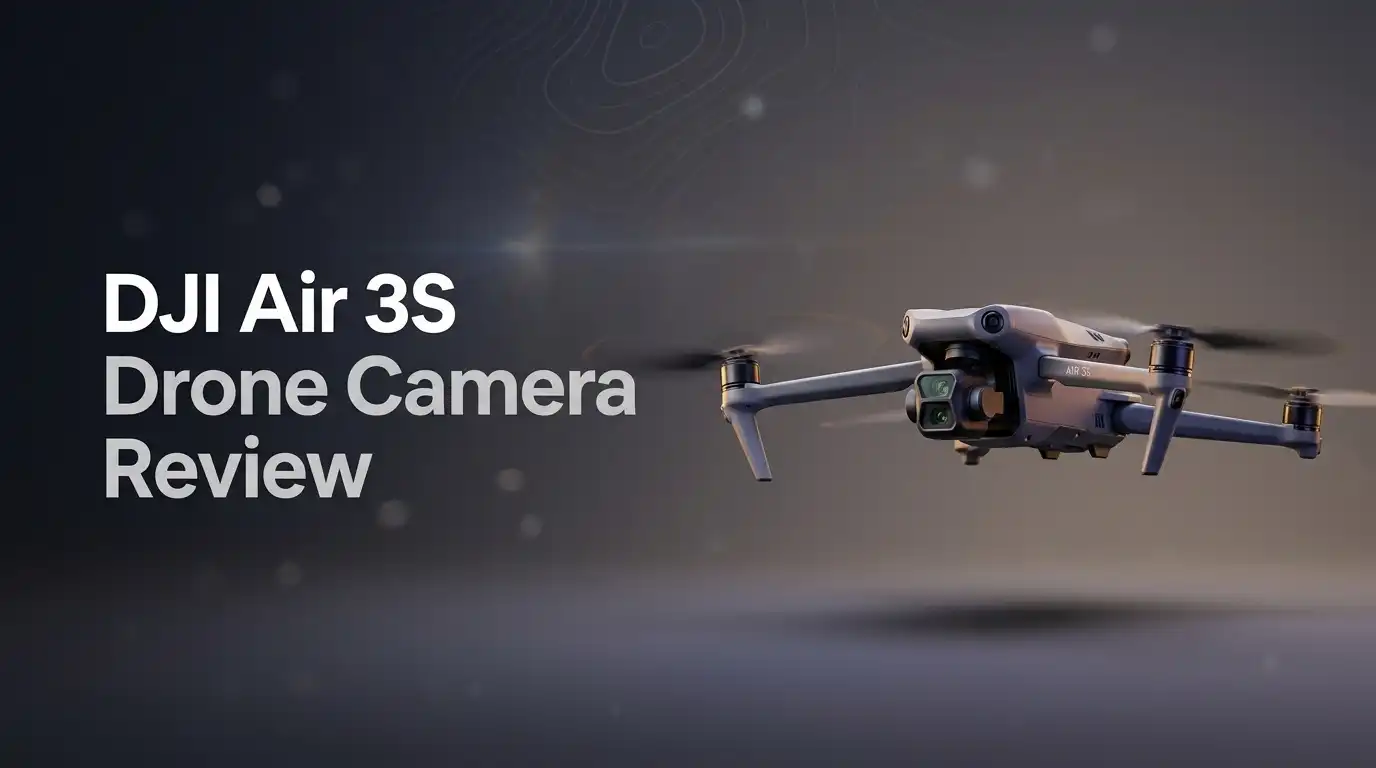
DJI Air 3S Drone Camera Review 2026: Still Worth It?
The DJI Air 3S sits in a strange and wonderful spot. It is not the cheapest drone you can buy. It is also not the flagship.
Yet two years after launch, it keeps showing up in the bags of travel creators, real estate shooters, and weekend hobbyists who just want good footage without drama. That staying power says something.
This review covers real flying behaviour, not marketing copy. You will read about the 1 inch sensor, the second tele camera, the LiDAR sensor that helps at night, and the battery that promises 45 minutes but rarely gives it.
Key Takeaways:
- The camera is the main reason to buy it. The wide camera uses a 1 inch 50MP CMOS sensor with a fast f/1.8 lens. It holds detail at sunset, keeps noise low, and captures up to 14 stops of dynamic range in D Log M.
- Two cameras mean two looks. The 24mm wide lens handles landscapes. The 70mm medium tele camera compresses backgrounds and makes subjects pop. Switching between them mid flight feels natural after a day of practice.
- Flight time is good but not magic. DJI lists 45 minutes. Real flying with wind, movement, and filming gives most pilots 30 to 35 minutes per battery. Three batteries in the Fly More Combo solve this.
- Night flying got safer. A forward facing LiDAR sensor spots obstacles in the dark up to 25 metres away. It only looks forward, so backing up in darkness still needs care.
- The weak points are real. Fixed aperture forces you to buy ND filters. Video stops at 4K with no 5.4K option. The 724 g weight means registration in most countries.
- Value in 2026 is strong. Prices have dropped well below launch, which makes this one of the best money to image quality ratios on the market.
DJI Air 3S Fly More Combo Overview

- Enhanced Camera for Travel Shots - Air 3S's 1" CMOS primary camera delivers breathtaking shots with enriched detail in low-light scenarios like sunsets and nightscapes.
- Capture Footage with Vibrant Detail - Record cinematic 4K/60fps HDR video with up to 14 stops of dynamic range [4] to see intricate cloud textures and other details during sunrise and sunset.
Some of the links on this website are affiliate links, which means that at no additional cost to you, I earn a commission if you click through and make a purchase. I only recommend products and services that I believe will add value to my readers. Thank you for your support!
The Fly More Combo is the version most people should pick. You get the drone, the DJI RC 2 screen controller, three Intelligent Flight Batteries, a charging hub, extra propellers, and a shoulder bag. The RC 2 has a built in 5.5 inch screen, so your phone stays in your pocket and your battery stays full.
The drone weighs 724 g and folds down to roughly the size of a water bottle. It carries 42 GB of internal storage, which has saved more than one flight after a forgotten memory card. Build quality feels dense and solid, with tight hinges and arms that lock with a firm click.
The combo costs more upfront than the base kit. It still works out cheaper than buying the controller and batteries separately later.
Unboxing Experience: What The Box Feels Like
DJI keeps packaging simple now. The outer sleeve slides off a plain grey box. Inside, the shoulder bag sits on top, zipped and padded, with everything tucked inside it. There is no plastic waste theatre, which is a nice change.
Lifting the drone out, the first surprise is the weight. It feels heavier than photos suggest. The gimbal cover snaps on snugly and protects both lenses properly. The three batteries sit in a neat row inside the bag, each at storage charge, so expect a wait before your first flight.
Setup takes about twenty minutes. You charge the RC 2, update firmware through the DJI Fly app, and activate the drone. The firmware update is the slow part, often eating fifteen minutes on its own. After that, the arms unfold, the props spin, and you are flying.
Camera Quality: Does The 1 Inch Sensor Deliver?
Yes, and the gap shows most in bad light. The wide camera pairs a 1 inch 50MP sensor with an f/1.8 lens. That combination pulls in far more light than the smaller sensors found in mini drones. At golden hour and after sunset, images stay clean while smaller sensors start smearing detail.
Photos come out as 12MP by default using pixel binning, which gives the cleanest files. You can switch to full 50MP for daylight shots that you plan to crop or print. DNG raw files hold impressive shadow detail, letting you lift dark areas without ugly colour blotches.
Colour science is pleasant straight out of camera, with natural greens and skin tones that do not look oversaturated. The close focus distance of 0.5 m also lets you shoot surprisingly tight detail shots from low hover positions.
The 70mm Tele Camera: Useful Or Gimmick?
This is the camera that changes how you frame shots. The medium tele uses a 1/1.3 inch 48MP sensor behind a 70mm equivalent f/2.8 lens. It compresses distance, flattens layers, and makes mountains and buildings look dramatically closer together.
The practical benefit is distance. You can film a subject from further away, which keeps the drone quieter and less intrusive. Portraits, wildlife from a respectful distance, and tight architectural details all look better on the tele lens.
There is a trade. The smaller sensor and slower aperture mean the tele camera falls behind the wide camera once light drops. Noise appears sooner, and detail softens. Treat the tele as a daylight tool and you will love it. Use it at dusk and you will notice the difference immediately.
Top 3 Alternative for DJI Air 3S

- Ultra-Light, Palm-Sized Foldable Design - Compact and foldable, this palm-sized drone slips easily into a pocket and offers 42GB of internal storage for uninterrupted flying [7].
- 1-Inch CMOS With 4K/60fps HDR Video - 1-inch CMOS sensor captures 4K/60fps HDR video with sharp detail and vibrant colors for stunning high-quality footage.
Some of the links on this website are affiliate links, which means that at no additional cost to you, I earn a commission if you click through and make a purchase. I only recommend products and services that I believe will add value to my readers. Thank you for your support!
DJI Mini 5 Pro

- Hasselblad Main Camera - Mavic 3 Pro has a 4/3 CMOS sensor, 24mm format equivalent, f/2.8-f/11, 20 MP. The Hasselblad 4K drone camera supports shooting RAW photos with a dynamic range of up to 12.8 stops.
- FAA Remote ID Compliant - DJI Mavic 3 Pro complies with the FAA Remote ID rule. Please check the compliance document below to see the user guide for Remote ID, and you can visit the FAA's website for requirements of drone registration and Remote ID.
Some of the links on this website are affiliate links, which means that at no additional cost to you, I earn a commission if you click through and make a purchase. I only recommend products and services that I believe will add value to my readers. Thank you for your support!
DJI Mavic 3 Pro

- 𝗨𝗻𝗱𝗲𝗿 𝟮𝟰𝟵 𝗴, 𝗡𝗼 𝗥𝗲𝗴𝗶𝘀𝘁𝗿𝗮𝘁𝗶𝗼𝗻 𝗜𝘀 𝗥𝗲𝗾𝘂𝗶𝗿𝗲𝗱[1] - Travel light and skip registration for a user-friendly, easy-to-carry experience on all your journeys. Enjoy the fun of flying without the tedious application process and waiting time.
- For the latest aircraft firmware, 𝘁𝗵𝗲 𝗥𝗲𝗺𝗼𝘁𝗲 𝗜𝗗 𝘄𝗶𝗹𝗹 𝗼𝗻𝗹𝘆 𝗯𝗲 𝗮𝗰𝘁𝗶𝘃𝗮𝘁𝗲𝗱 𝘄𝗵𝗲𝗻 𝘁𝗵𝗲 𝗜𝗻𝘁𝗲𝗹𝗹𝗶𝗴𝗲𝗻𝘁 𝗙𝗹𝗶𝗴𝗵𝘁 𝗕𝗮𝘁𝘁𝗲𝗿𝘆 𝗣𝗹𝘂𝘀 𝗶𝘀 𝘂𝘀𝗲𝗱. If your drone needs to be registered, such as 𝗳𝗹𝗶𝗴𝗵𝘁𝘀 𝗳𝗼𝗿 𝗰𝗼𝗺𝗺𝗲𝗿𝗰𝗶𝗮𝗹 𝗽𝘂𝗿𝗽𝗼𝘀𝗲𝘀, 𝗽𝗹𝗲𝗮𝘀𝗲 𝗳𝗹𝘆 𝘄𝗶𝘁𝗵 𝘁𝗵𝗲 𝗜𝗻𝘁𝗲𝗹𝗹𝗶𝗴𝗲𝗻𝘁 𝗙𝗹𝗶𝗴𝗵𝘁 𝗕𝗮𝘁𝘁𝗲𝗿𝘆 𝗣𝗹𝘂𝘀.
Some of the links on this website are affiliate links, which means that at no additional cost to you, I earn a commission if you click through and make a purchase. I only recommend products and services that I believe will add value to my readers. Thank you for your support!
DJI Mini 4 Pro Fly More Combo
Video Performance: 4K, Slow Motion, And D Log M
Both cameras record 4K at up to 60fps in HDR, and both can push to 4K/120fps for slow motion. That is rare at this price. Frame rates of 240fps are available at 1080p for very slow moments, though quality drops noticeably there.
Colour options include standard, HLG, and D Log M. D Log M is the one to learn. It gives roughly 14 stops of dynamic range and 10 bit colour, which means skies hold their gradient instead of clipping to white. Grading takes a few minutes per clip, and the payoff is footage that matches larger cameras.
Vertical shooting is built in at 2.7K, using the full sensor rather than a crop. Social creators will use this constantly. Maximum bitrate reaches 130 Mbps, which is enough for clean edits.
Flight Time And Battery Reality
DJI quotes 45 minutes of flight and 41 minutes of hovering. Those numbers come from a wind tunnel at steady speed with the camera in photo mode. Your flights will not look like that.
In normal use, filming moves, fighting a light breeze, and climbing to altitude, expect 30 to 35 minutes of usable air time. That still beats most competitors and feels generous in practice. The low battery warning arrives with enough margin to fly home calmly.
Charging takes about 60 minutes per battery with the 100W adapter and hub. The hub charges three batteries in sequence, not at once, so a full set takes a few hours. Plan charging the night before a shoot day. The batteries also store power accumulation, letting you move charge from weaker cells into one battery for a quick extra flight.
O4 Transmission And Real Range
The Air 3S uses DJI O4 transmission with six antennas. On paper, the range reaches 20 km under FCC rules and 10 km under CE. Nobody should fly that far, since visual line of sight laws apply nearly everywhere.
What matters is signal stability close to home. In towns with heavy interference, expect a reliable link around 1.5 to 4 km. In open countryside or along a coast, the feed stays locked far beyond legal flying distance. The live view runs at 1080p 60fps with roughly 120 ms latency, which feels immediate.
Signal recovery is the quiet hero here. When you fly behind a building and lose frames, the picture usually snaps back within a second or two instead of dropping out completely.
LiDAR And Obstacle Avoidance After Dark
This is the headline upgrade over the older Air 3. The drone carries omnidirectional binocular vision sensors plus a forward facing LiDAR unit and a downward infrared sensor. Vision sensors need light. LiDAR does not.
At night, the LiDAR detects obstacles up to 25 metres ahead on reflective surfaces. Combined with Night Mode return to home, flying after sunset becomes far less nerve wracking than on older models. Landing in dim conditions also improves thanks to the infrared sensor underneath.
The limitation is direction. LiDAR only looks forward. Reversing, sideways moves, and upward climbs in darkness still rely on vision sensors that struggle without light. Some pilots also report false obstacle warnings when flying into strong low sun, which causes sudden braking.
Smart Flight Features Worth Using
ActiveTrack 360 is the standout. You draw a path on the dial in the app, and the drone circles, trails, or leads your subject along that path. Tracking holds well on runners, cars, and bikes, and the drone now keeps following even when the subject briefly disappears behind a tree.
Free Panorama lets you drag a box over the live view, and the drone shoots and stitches exactly that area. It saves time compared with fixed panorama modes.
Waypoint flight, Cruise Control, and MasterShots all return. Cruise Control deserves more attention than it gets, since it holds a steady speed and removes thumb shake from long cinematic pushes. QuickShots remain the fastest way to get a usable clip when you only have five minutes and one battery left.
What The DJI Air 3S Does Not Do Well
Honest reviews list the flaws, so here they are. The aperture is fixed at f/1.8 on the wide camera. In bright daylight, you cannot slow the shutter without ND filters, so budget for a filter set. Without them, footage looks choppy rather than cinematic.
Video tops out at 4K. There is no 5.1K or 6K option, which limits cropping room in post. The tele camera also loses quality quickly once light fades, so it is not a true low light second lens.
At 724 g, the drone needs registration in most regions and does not slip under the 249 g rule. Some owners report the gimbal focus wheel throwing errors, and the LiDAR occasionally brakes for obstacles that are not there. None of these are dealbreakers, but all are real.
Pros And Cons Of The DJI Air 3S
Pros
- Excellent 1 inch sensor with f/1.8 lens that handles sunrise, sunset, and low light far better than mini drones.
- Two genuinely useful focal lengths at 24mm and 70mm, both capable of 4K/60 HDR and 4K/120 slow motion.
- Forward LiDAR plus omnidirectional vision makes night flying and tight spaces safer.
- Long real world flight time of around 30 to 35 minutes per battery, with 45 minutes quoted.
- 42 GB internal storage saves flights when you forget a memory card.
- O4 transmission stays stable and recovers quickly from interference.
Cons
- Fixed aperture means ND filters are required gear, not optional extras.
- No 5.4K or 6K recording, so cropping room is limited.
- Tele camera performance drops noticeably in dim light.
- 724 g weight triggers registration and Remote ID rules in most countries.
- LiDAR only covers the forward direction.
- Occasional focus wheel errors and false obstacle alerts reported by owners.
Who Should Buy It In 2026
Buy the Air 3S if image quality matters more than pocket size. Travel filmmakers, property photographers, YouTubers, and landscape shooters get the most from the large sensor and dual lens setup. It is the best balance of camera, safety, and price in the midrange category.
Skip it if you want something you never register and can throw in a jacket pocket. A sub 249 g drone suits casual holiday clips better, and newer mini models now carry 1 inch sensors of their own.
Professionals shooting paid commercial work may still want a Hasselblad equipped flagship for the extra resolution and adjustable aperture. For everyone between those two groups, the Air 3S hits a sweet spot that few drones manage.
Price And Value Verdict
Launch pricing started at 1,099 USD for the base kit with the RC N3 controller and higher for the Fly More Combo. Two years on, street prices have fallen hard, with Fly More bundles regularly appearing well below original cost and the base kit dropping under 800 USD in some regions.

- Enhanced Camera for Travel Shots - Air 3S's 1" CMOS primary camera delivers breathtaking shots with enriched detail in low-light scenarios like sunsets and nightscapes.
- Capture Footage with Vibrant Detail - Record cinematic 4K/60fps HDR video with up to 14 stops of dynamic range [4] to see intricate cloud textures and other details during sunrise and sunset.
Some of the links on this website are affiliate links, which means that at no additional cost to you, I earn a commission if you click through and make a purchase. I only recommend products and services that I believe will add value to my readers. Thank you for your support!
That price movement changes the verdict. At full launch price, the Air 3S competed closely with newer mini drones. At discounted 2026 pricing, it offers more sensor and more battery per dollar than almost anything else. Check current listings before buying, since stock varies and deals move quickly.
Overall rating: 4.5 out of 5. The flaws are minor. The camera, the flight time, and the safety sensors make this an easy recommendation for anyone serious about aerial footage.
Frequently Asked Questions
Is the DJI Air 3S still worth buying in 2026?
Yes, especially at reduced prices. The 1 inch sensor, dual camera setup, and LiDAR night safety still compete well with newer releases. Only buy something else if you specifically need a drone under 249 g or higher resolution video.
Do I need to register the DJI Air 3S?
Yes in most countries. At 724 g, it sits well above the 250 g exemption threshold. In the United States you need FAA registration and Remote ID compliance. In Europe it carries a C1 class label.
How long does the DJI Air 3S actually fly?
DJI rates it at 45 minutes under test conditions. Real flights with camera work and light wind typically give 30 to 35 minutes. Carry at least two batteries for any serious shoot.
Does the DJI Air 3S need ND filters?
For video, yes. The aperture is fixed at f/1.8, so bright daylight forces very fast shutter speeds. ND filters restore natural motion blur and make footage look smoother.
Air 3S or Mini 5 Pro, which one wins?
The Mini 5 Pro wins on weight and regulation freedom. The Air 3S wins on the second tele camera, battery size, and wind resistance. Choose based on whether portability or shooting flexibility matters more to you.

Welcome to The File Fix. I’m Millie, and I review tech so you don’t have to suffer buyer’s remorse.
Navigating the endless sea of Amazon devices and gadget releases can feel like a full-time job. That’s why I do the heavy lifting. I dig past the unreliable 5-star reviews and shiny spec sheets to test how these devices actually hold up in the real world. Whether you’re looking for the best budget earbuds, a reliable power bank, or the latest smart home gear, you’ll find honest, no-nonsense breakdowns here.