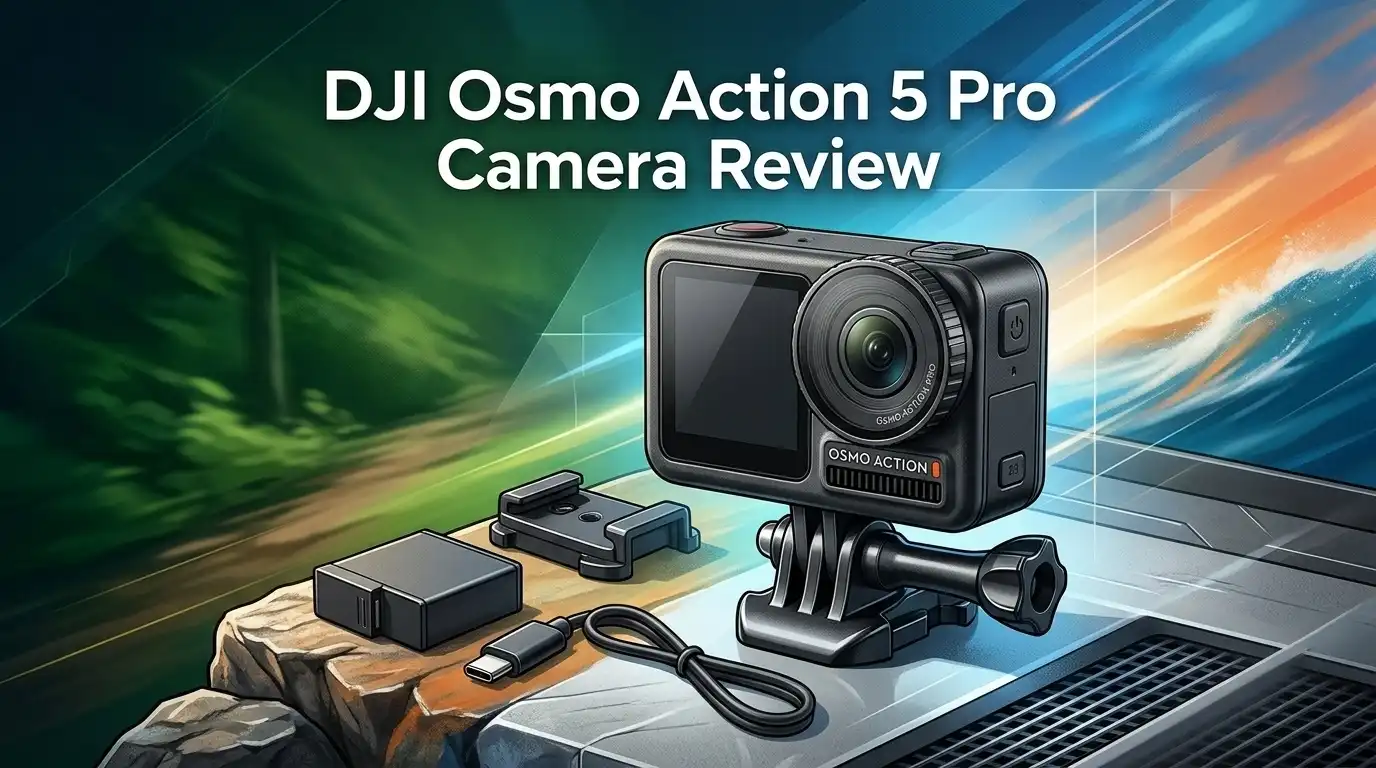
DJI Osmo Action 5 Pro Camera Review 2026: Still Worth It?
Action cameras get replaced fast. New models arrive, prices drop, and older cameras quietly become bargains. The DJI Osmo Action 5 Pro sits in that sweet spot right now.
It launched as a flagship, and in 2026 it costs far less than it did on day one. That makes it one of the most interesting buys in the category.
This review covers real use, not just a spec sheet. You will learn how the camera handles night rides, cold mornings, pool days, and long hikes. You will also learn where it falls short, because every camera has weak spots.
In a Nutshell:
- Low light is the star feature. The 1/1.3 inch CMOS sensor and SuperNight mode pull usable footage out of dim scenes. Night street rides, sunset surf, and indoor gyms look cleaner than most rivals at this price.
- Battery life beats almost everything. DJI rates the 1950 mAh cell at 240 minutes in a controlled test. Real world shooting at 4K lands closer to 90 minutes, which is still excellent.
- 47GB of usable internal storage saves forgetful people. You can leave the microSD card at home and still shoot a full day. This feature alone has rescued countless trips.
- Dual OLED touchscreens make framing easy. The 1.46 inch front screen and 2.5 inch rear screen are bright, sharp, and readable in direct sun.
- It is not perfect. There is no 5.3K or 8K option, the fixed f/2.8 lens cannot create background blur, and the magnetic mount can loosen under heavy vibration.
- Value in 2026 is strong. With list prices around $319 for the Standard Combo and frequent discounts, it undercuts newer flagships while keeping the features most people actually use.
DJI Osmo Action 5 Pro: What You Are Buying

- Pro-Grade Night & Dynamic Imaging - Discover breathtaking imaging quality with Osmo Action 5 Pro action camera 4K and its all-new 1/1.3" sensor. Advanced tech with 2.4 µm large pixels and 13.5-stop dynamic range delivers unmatched low-light performance and clarity.
- Always Centered, Always Focused - Achieve pinpoint accuracy with our advanced 4nm chip. DJI Osmo Action 5 Pro vlogging camera keeps fast-moving subjects perfectly centered in 16:9 or 9:16—ideal for vlogging, cycling, or capturing friends and pets in action.[7]
Some of the links on this website are affiliate links, which means that at no additional cost to you, I earn a commission if you click through and make a purchase. I only recommend products and services that I believe will add value to my readers. Thank you for your support!
The Osmo Action 5 Pro is a waterproof action camera built around a 1/1.3 inch sensor. It records 4K video at up to 120fps and shoots 40MP stills. The body weighs 146 grams and measures 70.5 by 44.2 by 32.8 mm. That is pocket sized and light enough for a helmet mount.
DJI aimed this camera at creators who shoot in hard light conditions. The large sensor, f/2.8 aperture, and 10 bit color pipeline support that goal. You also get three microphones, Wi Fi 6, and Bluetooth 5.1 for fast transfers.
The Standard Combo includes the camera, one battery, and a quick release mount. The Adventure Combo adds two extra batteries and a multifunctional case. Most buyers should pick the Adventure Combo if they shoot all day.
Unboxing Experience and First Impressions
The box is small, flat, and surprisingly light. DJI uses recycled cardboard with a simple product photo on the front. There is no plastic clamshell, which feels good to open.
Inside, the camera sits in a foam cradle at the top. Lift that tray and you find the quick release adapter mount, a locking screw, a USB C cable, and the paperwork. The protective lens cover is already screwed onto the front.
First impressions are positive. The body has a soft matte finish that resists fingerprints. The rear screen feels like a tiny phone, bright and responsive from the first tap. Setup takes under five minutes. You power on, pick a language, scan a QR code with the DJI Mimo app, and start shooting.
One small complaint: the Standard Combo ships with only one battery. Order a spare on day one.
Design and Build Quality
This camera feels dense in the hand. The frame uses a metal core wrapped in textured plastic, and nothing creaks when you squeeze it. Buttons have a firm, clicky action that works with wet fingers and thin gloves.
The battery door sits on the side with a double latch. You slide the lock, then press the release. That two step design prevents accidental openings during crashes. The USB C port hides under a rubber flap on the same side.
The front lens uses a removable glass cover with standard threads. Scratch it and you replace a $20 part instead of the whole camera. That is smart design.
Weight distribution is balanced, so chest mounts sit flat. At 146 grams, it will not strain a helmet strap during a long session.
Top 3 Alternatives for DJI Osmo Action 5 Pro

- HB-Series Lenses With Auto Detection: HERO13 Black is compatible with the HB-Series Lenses that let you instantly set up your camera for a variety of specialty shots. The Ultra Wide Lens Mod is the ultimate POV lens for action-packed scenes and epic landscapes. The Macro Lens Mod captures close-up shots in stunning detail. Neutral Density Filters add motion blur to your footage and let you adjust the lighting in your shots with professional results. Try the Anamorphic Lens Mod for pro-level cinematic shots. HERO13 Black even detects when a lens or filter is attached and automatically adjusts its settings accordingly.
- Best-in-Class 5.3K Video: 5.3K video delivers breathtaking image quality with 91% more resolution than 4K and an incredible 665% more than 1080p. HERO13 Black captures the action with crisp detail and exacting image quality so any shot with any lens will look amazing. 5.3K video also lets you grab stunning photos up to 24.7MP from your footage using the GoPro Quik app.
Some of the links on this website are affiliate links, which means that at no additional cost to you, I earn a commission if you click through and make a purchase. I only recommend products and services that I believe will add value to my readers. Thank you for your support!
GoPro HERO13 Black

- Unbeatable Image Quality by Day and Night: Record 4K60fps slow-mo and utilize Active HDR for more vibrant shots. The new PureVideo mode redefines low light shooting in an action camera, bringing innovative AI noise reduction and improved dynamic range.
Some of the links on this website are affiliate links, which means that at no additional cost to you, I earn a commission if you click through and make a purchase. I only recommend products and services that I believe will add value to my readers. Thank you for your support!
Insta360 Ace Pro 2

- Superior Low-Light Performance with 1/1.3-inch Sensor - Struggling with grainy footage in low light? Osmo Action 4 action camera 4K uses 2.4μm pixel size for crisp results. Auto white balance adjusts color for true-to-life, flicker-free shots, even underwater.
- Pro-Grade Color Science - Worried your videos lack real-life colors? 10-bit color depth captures subtle shades, while D-Log M preserves more detail and dynamic range for professional editing later. Osmo Action 4 vlogging camera helps you enhance vibrant scenery.
Some of the links on this website are affiliate links, which means that at no additional cost to you, I earn a commission if you click through and make a purchase. I only recommend products and services that I believe will add value to my readers. Thank you for your support!
DJI Osmo Action 4
Video Quality and Resolution Options
The Osmo Action 5 Pro records 4K at 24, 25, 30, 48, 50, 60, 100, and 120fps. You can shoot 16:9 or 4:3, which helps if you crop for vertical social clips later. Slow motion reaches 240fps at 1080p.
Color is the strong point. The 10 bit D Log M profile holds highlight detail that cheaper cameras clip away. Skies keep their gradient instead of turning into white blobs. Skin tones look natural straight out of camera in standard mode.
Sharpness is high across the frame, with mild softening at the extreme edges of the 155 degree field of view. Max bitrate is 120 Mbps, which is enough for clean grading but not generous by professional standards.
The missing piece is resolution headroom. There is no 5.3K or 8K mode here, so heavy reframing in post reduces quality.
Low Light Performance That Actually Works
This is where the camera earns its reputation. The 1/1.3 inch sensor gathers far more light than the tiny chips used in budget cameras. Video ISO stretches to 51200, though you will rarely push that far.
SuperNight mode runs noise reduction in real time at 4K, 2.7K, and 1080p up to 60fps. Night rides through a city look clean, with readable signs and controlled grain. Street lights keep their shape instead of blooming into starbursts.
Compared to rivals, the difference shows most in mixed lighting. A dim bar, a campfire scene, or a sunrise hike all hold detail in the shadows.
Do not expect miracles in near darkness. Grain appears once the scene drops below candlelight levels, and fine detail smears. Still, this remains one of the best low light action cameras you can buy.
Stabilization: RockSteady and HorizonSteady
DJI offers four stabilization modes. RockSteady 3.0 handles general shake. RockSteady 3.0+ adds stronger correction with a slight crop. HorizonBalancing levels tilts up to 45 degrees. HorizonSteady keeps the frame level through a full 360 degree roll.
In practice, RockSteady 3.0+ handles mountain bike trails and running footage with ease. Footsteps vanish. Handlebar vibration disappears. The result looks close to gimbal footage without carrying a gimbal.
HorizonSteady works only at 1080p or 2.7K in 16:9 at 60fps or below. That limitation frustrates users who want level horizons at 4K. HorizonBalancing covers 4K but corrects less tilt.
One note: stabilization does not work in Timelapse or Slow Motion modes. Plan your shots around that restriction.
Battery Life You Can Trust
DJI rates the 1950 mAh battery at 240 minutes. That number comes from a lab test at 1080p 24fps with screens off, so treat it as a ceiling rather than a promise.
Real results still impress. Shooting 4K 30fps with RockSteady on and the rear screen active, most users get 85 to 100 minutes per charge. That is roughly double what older action cameras managed.
Cold weather barely dents it. The camera operates from minus 20 to 45 degrees Celsius, and the battery keeps working on ski days where other cameras quit. Fast charging brings the cell to 80 percent in about 20 minutes.
Standby power draw sits at 0.5W, so the camera sips power between takes. Two batteries cover almost any full day shoot.
Dual OLED Touchscreens and Daily Controls
Both screens use OLED panels, which matters more than it sounds. Blacks look truly black, and brightness hits 800 nits typical with a 1000 nit peak on the rear display. You can read menus in harsh midday sun.
The front screen measures 1.46 inches at 342 by 342 pixels. It is a full touchscreen, not a dumb preview, so vloggers can change settings while facing the lens. The rear screen measures 2.5 inches at 400 by 712 pixels.
Menu layout follows a simple swipe system. Swipe down for quick settings, up for shooting modes, left for playback. Learning the interface takes about ten minutes.
Wet fingers still cause occasional missed taps, which is why the physical record button matters.
Audio Quality and Microphone Options
Three microphones handle wind noise reduction and directional pickup. Audio records at 48 kHz 16 bit in AAC format. For an action camera, the built in sound is clean and clear in calm conditions.
Wind is the usual enemy. At bike speeds above 25 km/h, the noise reduction works hard and voices get thin. A simple foam windscreen fixes most of this.
The better answer is the DJI Mic system. The camera connects to DJI wireless microphones over Bluetooth with no receiver needed. Audio syncs automatically and sounds dramatically better for vlogs and interviews.
There is no 3.5mm jack. You need a USB C adapter for wired microphones, and that adapter blocks the waterproof seal.
Waterproofing and Underwater Shooting
The camera survives 20 meters of water with no case. Add the dive case and that rises to 60 meters. Both carry an IP68 rating. For most people, the naked camera is enough for pools, snorkeling, and surf.
Before you swim, close the battery door, seal the USB C flap, and tighten the lens cover. Skipping any step risks a flood. DJI warns against hot springs and corrosive liquids.
Underwater color shifts blue quickly, as it does with every camera. The dive mode color correction helps down to about five meters. Below that, you need a red filter.
The glass lens cover fogs occasionally when you move from warm air into cold water. An anti fog insert solves it.
Magnetic Quick Release Mounting System
DJI uses a magnetic quick release that snaps the camera into place in under two seconds. Two side latches lock it down. Removing the camera means squeezing both latches and pulling.
This beats the traditional folding finger mount for speed. Switching from chest to helmet to handlebar takes seconds instead of a minute of thumbscrew fiddling.
The system is also backward compatible with Action 3 and Action 4 accessories. Existing DJI owners keep their mounts.
The weakness shows under sustained vibration. On rough gravel or dirt bike engines, the latch can work loose over time. Check it between runs, or add a safety tether for peace of mind.
Software, App, and Editing Workflow
The DJI Mimo app connects over Wi Fi 6, and transfers are fast. A one minute 4K clip moves to a phone in roughly 15 seconds. The app includes templates, music, and basic trimming for quick social posts.
Pairing is reliable, which was not always true of older DJI apps. The live preview runs smoothly with minimal lag.
Files save as MP4 using HEVC compression. That keeps file sizes small but demands a capable computer for smooth editing. Older laptops will stutter on 4K 120fps timelines. Transcoding to ProRes solves it at the cost of disk space.
Desktop software support is thinner than GoPro’s ecosystem. There is no full featured desktop editor from DJI, so you rely on third party tools.
What the DJI Osmo Action 5 Pro Does Not Do Well
Honest reviews need honest criticism. Here are the real weaknesses.
Resolution caps at 4K. Competitors offer 5.3K and 8K, which gives them cropping flexibility this camera lacks. If you reframe heavily in post, that matters.
The fixed f/2.8 lens has deep focus and no background separation. Your vlog footage will always look like action camera footage, never like a mirrorless shot.
Overheating appears during long 4K 120fps sessions in hot sun, usually after 20 to 25 minutes. The camera throttles rather than shutting off, but it happens.
Photo quality lags behind phones. The 40MP stills look soft when you pixel peep, and dynamic range trails a modern smartphone. Treat this as a video camera first.
Pros and Cons
Pros
- Outstanding low light video for an action camera, thanks to the 1/1.3 inch sensor and SuperNight mode
- Class leading battery life with a 1950 mAh cell and fast charging
- 47GB of usable internal storage works as a backup when you forget a card
- Dual OLED touchscreens stay readable in bright sunlight
- Waterproof to 20 meters with no case required
- Magnetic quick release mounting saves time between shots
- 10 bit D Log M color gives real grading flexibility
- Strong value in 2026 as prices fall below newer rivals
Cons
- No resolution above 4K limits cropping and future proofing
- Fixed aperture lens cannot produce shallow depth of field
- Overheating during extended 4K 120fps recording in heat
- No 3.5mm microphone jack without a sealing breaking adapter
- HorizonSteady restricted to 1080p and 2.7K at 60fps or below
- Magnetic mount can loosen under heavy engine vibration
- Photo quality trails a modern smartphone
- Standard Combo includes only one battery
Who Should Buy the Osmo Action 5 Pro in 2026
Buy this camera if you shoot in changing light. Night riders, early morning hikers, divers, and indoor sports shooters get the most benefit from the big sensor.
It also suits travelers. The long battery, internal storage, and light body mean fewer accessories in your bag. One camera, two batteries, and you are set for a full day.
Motorcyclists and cyclists will like the quick release mounts and the 155 degree field of view.
Skip it if you need maximum resolution. Creators who crop aggressively or deliver 8K should look elsewhere. Photographers should also look elsewhere, since stills are the weakest part of this package.
Final Verdict: Is It Worth Buying Now?
- Pro-Grade Night & Dynamic Imaging - Discover breathtaking imaging quality with Osmo Action 5 Pro action camera 4K and its all-new 1/1.3" sensor. Advanced tech with 2.4 µm large pixels and 13.5-stop dynamic range delivers unmatched low-light performance and clarity.
- Always Centered, Always Focused - Achieve pinpoint accuracy with our advanced 4nm chip. DJI Osmo Action 5 Pro vlogging camera keeps fast-moving subjects perfectly centered in 16:9 or 9:16—ideal for vlogging, cycling, or capturing friends and pets in action.[7]
Some of the links on this website are affiliate links, which means that at no additional cost to you, I earn a commission if you click through and make a purchase. I only recommend products and services that I believe will add value to my readers. Thank you for your support!
The DJI Osmo Action 5 Pro remains a smart purchase in 2026. Newer cameras exist, including DJI’s own follow up, but the gains are smaller than the price difference suggests. This camera still delivers the features most people use daily.
Low light video, battery life, and bright screens matter more in real shooting than a resolution number on a box. This camera wins on all three.
Expect to pay around $319 for the Standard Combo and $419 for the Adventure Combo at list price, with sales pushing both lower. At discount prices, it offers the best value in the category.
Rating: 4.5 out of 5. A reliable, practical action camera with clear strengths and honest limits.
Frequently Asked Questions
Is the Osmo Action 5 Pro better than the GoPro HERO13 Black?
It depends on your priority. The Osmo Action 5 Pro wins on low light video, battery life, and internal storage. The HERO13 Black wins on resolution with 5.3K, lens accessories, and a larger accessory ecosystem. For night and dim shooting, pick DJI. For maximum detail and modular lenses, pick GoPro.
How long does the battery actually last?
DJI claims 240 minutes in a controlled 1080p test. Real world 4K 30fps shooting delivers 85 to 100 minutes with the screen on. Cold weather reduces this slightly, but less than with most rivals. Carry one spare battery for a full day of shooting.
Can I use it underwater without a case?
Yes. The camera is waterproof to 20 meters on its own. Close the battery door, seal the USB C flap, and tighten the lens cover first. For dives beyond 20 meters, use the dedicated waterproof case rated to 60 meters.
Does it overheat during long recordings?
It can. Recording 4K 120fps in direct sun triggers thermal throttling after roughly 20 to 25 minutes. At 4K 30fps, the camera runs much longer without issue. Keeping it out of direct sunlight between takes helps a lot.
Do I need a microSD card?
Not immediately. The camera includes 47GB of usable internal storage, which holds roughly one hour of 4K 60fps footage. A microSD card up to 1TB extends that, and a V30 rated card is the minimum for high bitrate modes.
Does it work with DJI wireless microphones?
Yes. The camera pairs directly with DJI Mic transmitters over Bluetooth without a receiver. Audio quality improves dramatically for vlogs and interviews. There is no 3.5mm jack, so wired microphones need a USB C adapter that breaks the waterproof seal.

Welcome to The File Fix. I’m Millie, and I review tech so you don’t have to suffer buyer’s remorse.
Navigating the endless sea of Amazon devices and gadget releases can feel like a full-time job. That’s why I do the heavy lifting. I dig past the unreliable 5-star reviews and shiny spec sheets to test how these devices actually hold up in the real world. Whether you’re looking for the best budget earbuds, a reliable power bank, or the latest smart home gear, you’ll find honest, no-nonsense breakdowns here.